
Incogni vs Optery: What the Cheap Tier Actually Does
Search this comparison and you can still find comparison pages written by the companies themselves: Optery publishes an Incogni comparison, and Incogni publishes an Optery review/comparison. Those pages are useful source material, but each vendor has an obvious interest in how the comparison is framed.
The more useful question for a household is narrower: what do the lower-cost plans actually do, and what changes when you move up a tier?
Nesswick pays neither company and has subscribed to neither service. The plan details below were re-checked against current Incogni and Optery official pages on October 4, 2026.
One new context point matters: Optery announced on September 10, 2026 that it had joined Surfshark Group, the same broader group that includes Incogni. Optery says it remains a standalone company with its own brand, product roadmap, customer engagement model and technical infrastructure. Readers should therefore understand that these are now sister brands within the same group, even though the products remain separately operated.
Before either of them: the free routes
Optery still offers a Free Basic tier with no credit card required. It includes a personalized exposure report with screenshots, Google and Bing exposure scanning, self-service removal tools, phone and email scan preferences, profile visibility at hundreds of sites, and self-service support for unlimited name variations and past cities/states. The free tier does not perform paid automated removals for you.
Incogni does not currently list a free ongoing tier on its pricing page. It does advertise a money-back guarantee on paid plans.
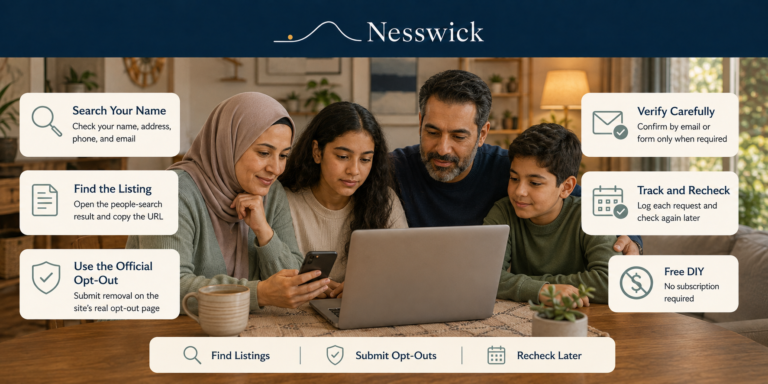
Manual opt-outs can also cost nothing. Nesswick’s people-search opt-out and data-removal-service-vs-DIY guides explain when doing the work yourself may be enough.
The cheap tiers are not the same product
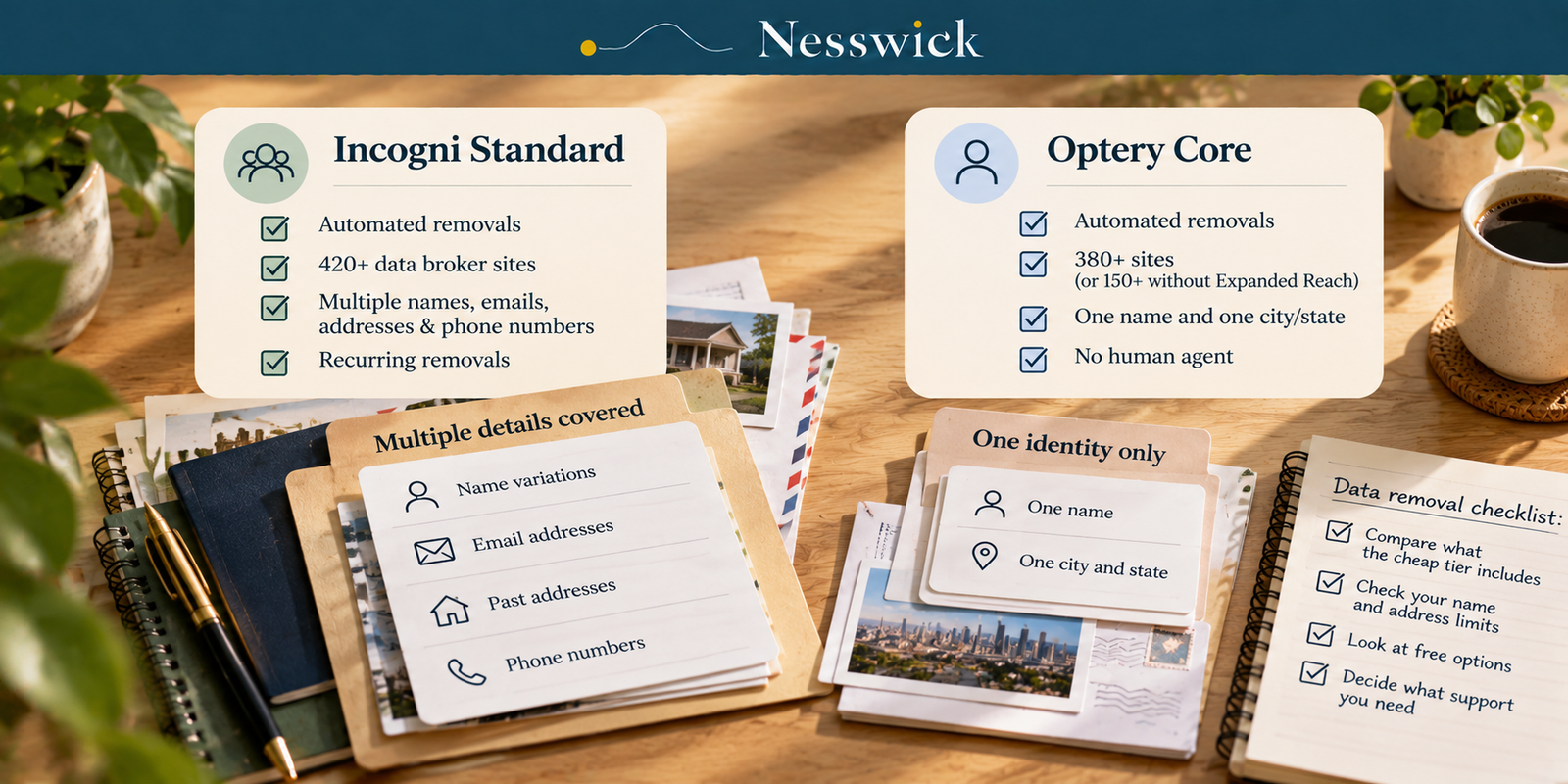
Incogni Standard currently lists automated removal from 420+ data broker sites, removal of multiple emails, addresses and phone numbers, and recurring removals.
Optery Core currently lists automated removals from 380+ sites, or 150+ sites without Expanded Reach. Its key limitation remains: automated removals support a maximum of one name and one city and state per user. Optery also still states that Core is fully automated and does not assign a human Privacy Agent for QA or special circumstances.
That makes the distinction practical rather than cosmetic. Someone with several historical names or locations may outgrow Core’s automated-removal identity limit even if its site count looks sufficient. Incogni Standard, by contrast, explicitly supports multiple emails, addresses and phone numbers.
The higher tiers buy different things
| Incogni Unlimited | Optery Extended | |
|---|---|---|
| Current annual-billing equivalent | $14.99/month ($179.88/year) | $12.42/month ($149/year) |
| Automated coverage | 420+ data broker sites | 560+ sites (330+ without Expanded Reach) |
| Main addition | 3,000+ additional sites for custom removal; unlimited custom removal requests; live phone support | Unlimited name variations and past cities/states; assigned human Privacy Agent; before/after removal reports about every 90 days |
| Family structure | Separate Family and Family Unlimited plans, up to 5 members | Optery for Family supports unlimited invited members; paid-plan discounts increase with the number of paid members |
Incogni’s premium step is primarily broader custom-removal reach beyond its automated list. Optery Extended’s step is primarily more identity variations, human handling for special circumstances, and screenshot-based removal reporting.
Optery also sells an Ultimate tier above Extended. Because this article is about the inexpensive tier and its nearest higher-tier contrast, Ultimate is not used as the main comparison, but it should not be described as unpublished or unverified.
Current pricing
Optery’s current U.S. pricing page shows Core at $3.99/month on monthly billing or $3.25/month ($39 billed yearly). Extended is $14.99/month on monthly billing or $12.42/month ($149 billed yearly). The page currently states a 30-day money-back guarantee and cancel-any-time terms.
Incogni’s standing U.S. annual prices are currently listed as Standard $7.99/month ($95.88/year), Unlimited $14.99/month ($179.88/year), Family $15.99/month ($191.88/year), and Family Unlimited $22.99/month ($275.88/year). Incogni may display temporary first-year promotions or coupon-specific pricing, so promotional figures should not be treated as permanent list prices.
Family coverage is now published by both
Optery for Family allows an account administrator to invite unlimited loved ones; each person has a separate Optery account. Optery currently documents discounts of 20% for two paid plans, 25% for three, and 30% for four or more paid plans. Family members can use different tiers, but the billing term must match.
Incogni publishes separate Family and Family Unlimited plans for up to five members with family account management. The two companies therefore both publish household options, but they structure them differently.
Where you have to live
Incogni currently supports residents of the United States and specified U.S. territories, Canada, the United Kingdom including the Isle of Man, Switzerland, Norway, Iceland, Liechtenstein, and European Union countries listed in its help documentation.
Optery now publishes consumer availability clearly. Personal and family accounts are currently available in the United States, Canada excluding Quebec, Australia, New Zealand and South Africa. Optery says business coverage can extend beyond those consumer markets depending on the organization.
Which one suits which problem
Optery Free Basic suits someone who wants to see what is exposed before paying. Optery Core is a low-cost automated option for a relatively simple identity profile, but its automated-removal limit of one name and one city/state is important. Optery Extended is the more appropriate Optery tier when multiple names or past locations, human handling, or screenshot reporting matter.
Incogni Standard suits someone who wants automated recurring removals with support for multiple emails, addresses and phone numbers. Incogni Unlimited is the relevant step up when custom-removal breadth is the priority.
For households, both vendors now publish family arrangements, so the choice should be based on member count, tier mix, geography, identity complexity and the type of removal workflow you want – not on the outdated assumption that only Incogni publishes family pricing.
What documentation cannot tell you
Neither service has been run by Nesswick for this comparison, so this article does not measure removal success rate, removal speed, how long removals hold, support quality, or the experience of resolving a difficult case. Vendor plan pages can establish features and limits; they cannot establish real-world outcomes.
No data-removal service should be described as removing every trace of a person, making removal permanent, or preventing identity theft. A smaller public data footprint can be useful, but it is not the same thing as fraud prevention.


Related Resources

official pricing page
official pricing page
Affiliate Disclosure
Current relationship: Nesswick does not currently use affiliate links in this article. Product and service references are included for editorial purposes.
Sources and Methodology
This comparison was prepared without subscribing to either service. Prices, plan limits, site counts, family structures and geographic eligibility were re-verified on October 4, 2026 from current official Incogni and Optery pages. Standing annual prices are separated from temporary or coupon-specific promotions. Optery’s Core one-name/one-city-and-state automated-removal limit and no-human-Privacy-Agent statement are taken from its current pricing page. Optery’s family and country availability are now included because the company publishes them directly. Optery’s September 2026 announcement that it joined Surfshark Group is disclosed because Incogni is also part of that broader group. Nesswick names no winner and makes no claim about removal effectiveness, speed, persistence, support quality or any other outcome not established by documentation.
Last reviewed and verified: October 4, 2026.
Sources Referenced
- Incogni – Pricing
- Incogni Help Center – In which countries is Incogni available?
- Incogni – About Us
- Incogni – Optery Review
- Optery – Pricing
- Optery Help Desk – Plans & Pricing
- Optery Help Desk – Optery for Family
- Optery Help Desk – Country availability
- Optery – Incogni vs Optery
- Optery – Joins Surfshark Group