
Aura vs LifeLock: Four Structural Differences That Decide It
Aura and LifeLock both offer identity monitoring, credit-related alerts, recovery assistance and reimbursement benefits. The useful comparison is not which brand has the larger headline number. It is which plan covers the bureaus, people and additional services your household actually needs, at a price you can sustain.
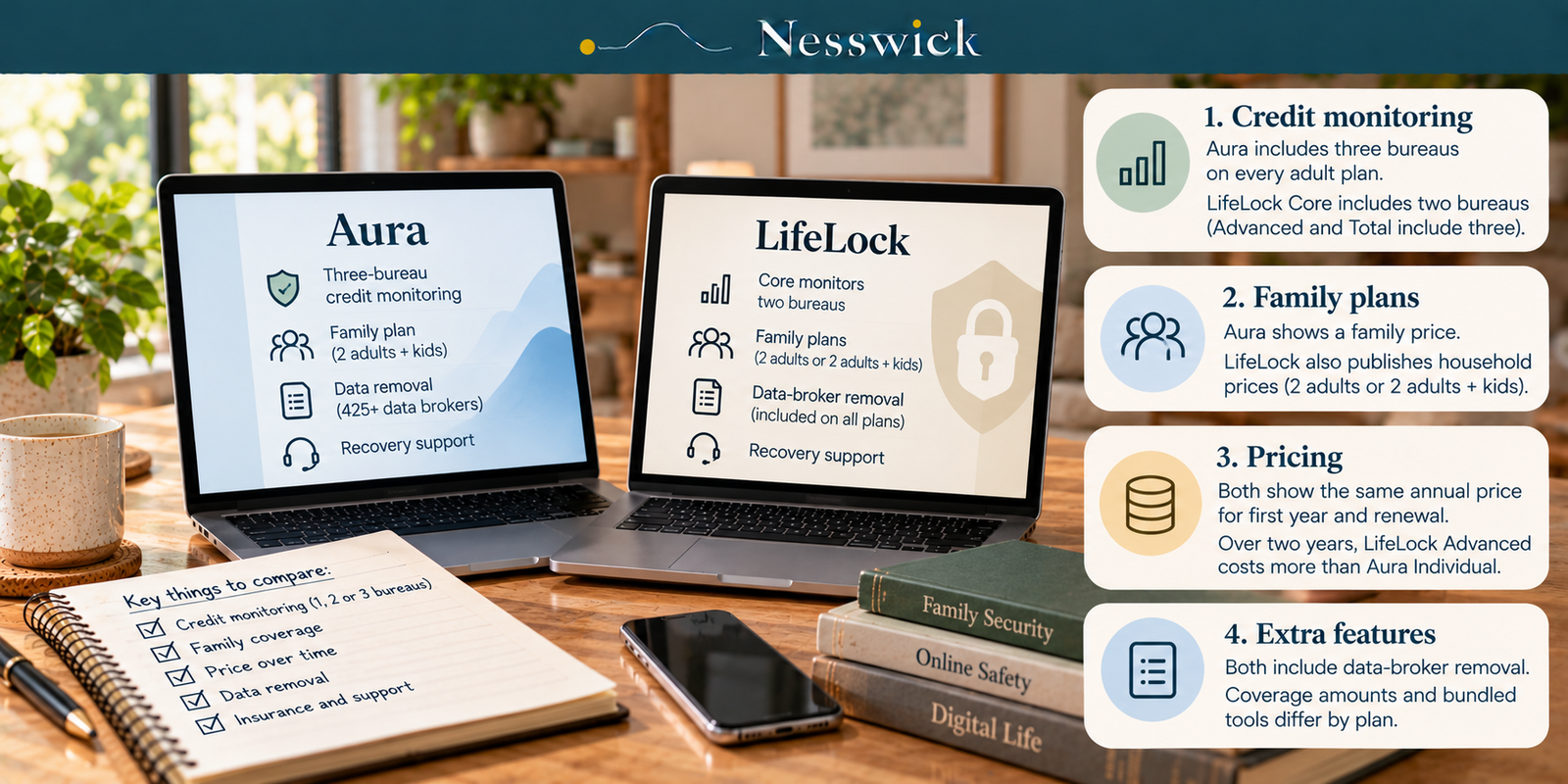
Four differences still organize the decision: credit-bureau coverage, the price at the time of purchase and renewal, household configurations, and the tools included beyond identity monitoring. They no longer point in the directions claimed by an earlier version of this article. There is no universal winner.
This is a research-based assessment of official documentation. Nesswick has not purchased, operated or tested either service and does not compare real-world alert accuracy or support speed.
Before either subscription: the free foundation
Consider placing a free credit freeze separately at Equifax, Experian and TransUnion. A freeze restricts access to your credit file for most new-credit applications; it is not an all-purpose block on every form of fraud. Fraud alerts are free, official credit reports are available free, and IdentityTheft.gov provides free recovery guidance. These steps complement, rather than duplicate, paid monitoring.
Difference one: how many bureaus are monitored
Aura lists three-bureau credit monitoring on Individual, Couple and Family adult plans. LifeLock Core now lists two-bureau credit monitoring, while LifeLock Advanced and Total list three-bureau monitoring. That is a narrower gap than the old one-bureau claim: Core is not a three-bureau match, but it is no longer a one-bureau plan.
A credit report or score supplied from three bureaus is not the same thing as continuous monitoring of all three. Check the exact credit-monitoring line on the plan you intend to buy, including any Norton 360 with LifeLock bundle, rather than treating every LifeLock product as equivalent.
Difference two: the actual price, including renewal
The official LifeLock annual plan cards and Norton renewal price list currently show the same annual amounts for the first year and renewal on Core, Advanced and Total. The old statement that these plans renew at $149.88, $239.88 and $419.88 is not supported by the current pages. Monthly billing is a different price, and all published rates can change with notice.
| Individual plan | Annual rate shown | Two years at shown rate | Bureau monitoring |
|---|---|---|---|
| Aura Individual | $144.00 | $288.00 | Three |
| LifeLock Core | $124.99 | $249.98 | Two |
| LifeLock Advanced | $199.99 | $399.98 | Three |
| LifeLock Total | $349.99 | $699.98 | Three |
At three-bureau coverage, Aura Individual is $111.98 less than LifeLock Advanced across two years at the displayed annual prices ($399.98 minus $288.00). Against LifeLock Core, Aura Individual is $38.02 more across two years, while offering three-bureau rather than two-bureau monitoring. These are illustrative totals at currently listed rates, not guaranteed future bills; eligibility, taxes, promotions and later price changes can affect actual charges.
Aura lists Individual at $12 per month billed annually or $15 billed monthly; Couple at $22 annually billed per month or $29 monthly; Family at $32 annually billed per month or $50 monthly; Kids at $10 annually billed per month or $13 monthly. The annual equivalents are $144, $264, $384 and $120. Do not confuse the advertised annual-billing monthly equivalent with a month-to-month subscription.
Difference three: household pricing and membership
Both providers now publish household prices. Aura offers Couple for two adults and Family for up to five adults plus unlimited children, with parental controls on Family. Its Kids plan is for parental controls and child safety features, not an adult identity-monitoring subscription. LifeLock publishes separate annual options for one adult, two adults, and two adults plus children; the listed children configuration covers up to ten minors.
| LifeLock plan | 1 adult | 2 adults | 2 adults + kids |
|---|---|---|---|
| Core | $124.99 | $224.99 | $344.99 |
| Advanced | $199.99 | $359.99 | $479.99 |
| Total | $349.99 | $629.99 | $749.99 |
The household distinction is now about how many adults and children are included, what each person receives and what that configuration costs, not about whether LifeLock publishes prices at all. Aura Family accommodates up to five adults; the LifeLock household choices shown above center on two adults. Verify dependent eligibility and coverage limits before enrolling.
Difference four: what is included beyond identity monitoring
Both providers now offer a data-removal feature. Aura lists removal from 425+ data brokers, people-search sites, junk-mailers and Google search results, together with unused digital account cleanup, on adult plans. LifeLock now lists Automatic Data Broker Removal on Core, Advanced and Total; its published footnote says the service scans and requests removal every 90 days after setup. These are different described services and should not be treated as identical in coverage or effectiveness.
Aura adult plans also list antivirus, VPN and password manager tools; its Family plan adds parental controls and child-wellbeing features. LifeLock standalone plans include identity and financial monitoring features, while separate Norton 360 with LifeLock bundles combine identity services with Norton device security. Compare the specific bundle and device allowance instead of claiming that only one company offers privacy or device tools.
Insurance and reimbursement: compare policy categories, not headlines
Aura advertises identity-theft insurance of $1 million on Individual, $2 million on Couple and $5 million on Family, structured around eligible adult coverage and subject to the applicable policy, limits and exclusions. LifeLock Core advertises up to $1.05 million identity-theft reimbursement including up to $25,000 for stolen funds; Advanced up to $1.2 million including up to $100,000 stolen funds; Total up to $3 million including up to $1 million stolen funds. These totals are not interchangeable with cash-loss reimbursement, and none is a guaranteed payout.
Read each provider’s actual insurance or reimbursement terms, particularly sublimits, eligibility, exclusions and claims procedures. Do not infer that a higher headline figure means broader coverage for your particular loss.
Aura may fit if
You want three-bureau monitoring at the lowest adult tier Aura sells, a plan covering more than two adults, or a package that explicitly includes parental controls on its Family plan. Its published data-removal and digital-account-cleanup descriptions may also matter, but data removal is no longer exclusive to Aura.
LifeLock may fit if
You prefer a lower-priced two-bureau Core plan, want to choose among standalone three-bureau tiers with different reimbursement ceilings, or need a two-adult household configuration with a published price. If you already want Norton device security, compare the separately marketed Norton 360 with LifeLock bundles on their own terms.
Neither may be necessary if
You mainly want to reduce the risk of new-account credit fraud and have not yet placed free freezes. Start with those protections and free recovery resources. Paid services may add convenience, alerts and assistance, but they do not prevent every kind of identity theft.
What this comparison cannot establish
Nesswick has not tested either service. This review cannot establish which detects misuse sooner, whose alerts are more accurate, how quickly specialists answer, how well removals succeed or how claims are resolved. Product features and prices are based on the official pages identified below as checked on 9 October 2026; confirm them again if publication is delayed.



Related Resources

official FTC reporting and recovery service
federally authorized free credit-report source
Affiliate Disclosure
Current relationship: Nesswick does not currently use affiliate links in this article. Product and service references are included for editorial purposes.
Sources and Methodology
This research-based assessment uses publicly displayed provider plan descriptions, annual and monthly prices, the Norton renewal price list effective March 2026, and FTC consumer guidance. No account was purchased or used. All annual and two-year totals were calculated directly from the listed amounts. Coverage, data-removal features, reimbursement and insurance are described as provider claims, not independently tested outcomes. This revision replaces the earlier unsupported claim that LifeLock Core monitors one bureau, renews at a higher listed annual rate, lacks published family prices or lacks automatic data broker removal.
Last reviewed: 9 October 2026.