
Unpaid Toll Text Scam: How to Tell If a Text Is Fake
A text arrives saying you owe $12.51 for an unpaid toll. There is a late fee mentioned, a deadline, and a link. You do not remember the toll, but you did drive somewhere last month, and the amount is small enough that paying feels easier than checking.
That hesitation is the whole point of the scam. Toll, DMV, and delivery scam text messages are all built around it.
Short Answer
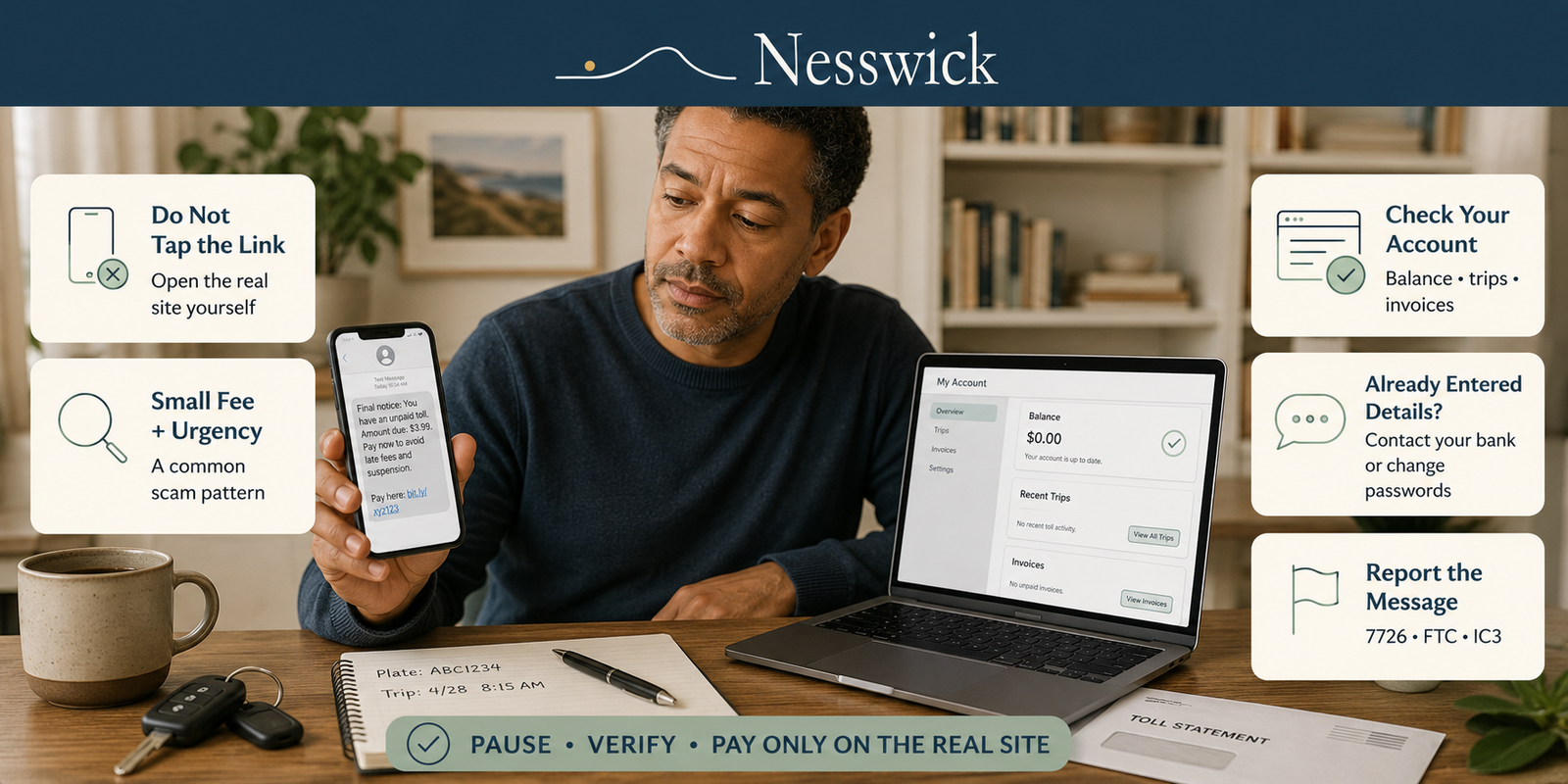
Most unexpected texts asking you to pay a toll, traffic ticket, or delivery fee through a link should be treated as suspicious until you verify them independently. The safest response takes about a minute and costs nothing: do not tap the link, open your browser yourself, and check your account on the toll agency’s or DMV’s real website. If you owe something, it will show up there. If it does not, you have your answer.
The FTC’s guidance on these messages is short and practical: “Don’t click on any links in, or respond to, unexpected texts,” then check with the tolling agency “using a phone number or website you know is real, not the info from the text.”
Why These Texts Show Up So Often
In April 2024, the FBI’s Internet Crime Complaint Center (IC3) published a public service announcement about a wave of smishing texts claiming people owed road tolls. IC3 said it had received more than 2,000 complaints in about a month, referencing toll services in at least three states, and that the messages typically claimed a small outstanding amount, often $12.51, with the threat of a late fee.
The pattern spread because it works. Toll systems are genuinely confusing. They vary by state, many people drive through toll roads without a transponder, and real toll-by-plate invoices do arrive later by mail. A scammer does not need you to believe the message completely. They only need you to be unsure enough to tap.
Since then, the same template has been reused for scams targeting drivers with DMV notices, traffic tickets, and parking fines, and for fake delivery fees. The wording changes. The mechanics do not.
The Fastest Way to Check a Toll Text
You do not need any software or subscription for this. You need a browser and a minute.
- Do not tap the link. Not to look, to check, not out of curiosity. Some of these pages are built to capture card details on the first screen.
- Do not reply. Not with “STOP,” not with “N,” not with anything. Replying can encourage further contact, so it is safer not to respond.
- Open your browser and type the agency’s address yourself. Search for the official state toll authority or transportation department if you are not sure which agency runs the road you used.
- Log in and look at your actual account. Check the balance, recent trips, and any invoices.
- Compare it to the text. If the toll agency shows nothing owed, the text was fake. If something is genuinely owed, pay it there, on the site you opened yourself.
If you would rather call, use the customer service number printed on the agency’s website or on a paper statement. Never use a phone number that appeared inside an unsolicited text.
Toll Names Scammers Copy
A toll road text scam usually names a real system, because familiarity lowers your guard. Seeing a name you recognize is not evidence that a message is real.
- E-ZPass. Used across many Eastern and Midwestern states. Fake versions usually claim a balance is overdue or that a stored payment card failed.
- SunPass. Florida’s prepaid toll program. Fake messages often reference a Florida toll road, sometimes to people who have never driven in Florida.
- FasTrak. Used in California for bridges, express lanes, and toll roads. Fake versions mention lane charges or account suspension.
- TxTag. A Texas toll program. Fake messages typically claim an invoice is past due or ask you to update a payment method.
- Generic express lanes. Many states run express, managed, or HOT lanes. Scam texts often use vague wording like “state express lane violation” without naming any real agency, because vagueness travels across state lines.
If a message names an agency you have never used, that is a strong signal on its own. But even if it names your agency correctly, the check is the same: go to the site yourself.
DMV Scam Text and Traffic Ticket Variants
In July 2025, the FTC published an alert about texts claiming an overdue traffic ticket. According to the FTC, these messages impersonate state DMVs and threaten to suspend your vehicle registration, license, and driving privileges, add a 35% fee, pursue prosecution, and damage your credit.
That stack of threats is deliberate. Real agencies rarely list five consequences in one message.
Genuine DMV and court matters, including registration renewals, citations, and camera notices, still arrive mostly by mail or through a secure online account you log in to. Some agencies do send opt-in text reminders, but those reminders point you to log in, not to pay from the message.
To check one, go directly to your state DMV or motor vehicle agency site, or your city or county court or parking office. If the text quotes a citation number, do not enter that number into the linked page. Use the official site’s ticket lookup instead.
This one matters for households with more than one driver. A parent may get a text about a car a teenager drives. Before anyone pays anything, confirm who was driving, check the mail, and look the notice up on the real site.
USPS Scam Text and FedEx Delivery Variants
The delivery version is the same trick in different clothing: a package is held, an address needs confirming, a small redelivery fee is due.
The U.S. Postal Inspection Service describes these as smishing, texts designed to get personal or financial information, and its advice is direct: do not click the link, and check tracking at USPS.com instead.
FedEx-style versions usually mention a shipment exception, customs charge, or missed delivery. Real carriers do send tracking updates, especially if you or a seller signed up for them, which is exactly why the fake ones land. If you are expecting something, check the tracking number from your order confirmation on the carrier’s own site, not from the text.
Red Flags These Messages Share
You do not need to identify the specific scam. You need to notice the shape of it. The same red flags run through a toll payment text scam, a DMV notice, and a delivery fee message.
- A manufactured sense of urgency: a short deadline, or wording like “final notice,” “immediately,” or “today”
- A stack of threats: late fees, suspension, collections, prosecution, credit damage
- A link that is shortened, misspelled, or only close to the real agency’s address
- A request for card numbers, bank details, gift cards, a driver’s license number, a Social Security number, or a verification code
- An unfamiliar sender number, sometimes with an international country code
- A small dollar amount, low enough that paying feels cheaper than checking
- A generic greeting with no account number, plate number, or other detail a real government agency would already have
- An instruction to reply “Y,” or to copy the link into your browser because it “will not open”
That last one is worth knowing. Some phones disable links in messages from unknown senders, so scammers ask you to work around your own phone’s protection.
These signals are not unique to toll texts. They show up in almost every phishing message, and our guide on how to spot a phishing email or text covers the same checks for email, links, and verification codes.
What to Do If You Already Tapped the Link
Tapping a link is not the same as handing over sensitive information. Take the steps that match what actually happened.
If you tapped but entered nothing:
- Close the page and do not download anything from it.
- Decline any request to install a profile, app, or certificate.
- Do not enable notifications for the site.
- Take a screenshot for reporting, then delete the message.
- Expect follow-up scam attempts using the same story, by text or by phone, and treat those the same way.
If you entered card or bank details:
- Call your bank or card issuer now, using the number on the back of your card or inside the official app.
- Ask about replacing the card and what protections apply to your situation.
- Review recent transactions carefully, including small unfamiliar charges.
- Turn on transaction alerts if your bank offers them. They are usually free.
- Write down what you entered and when. It helps if you need to dispute a charge later.
If you entered a password, change it on the real site, and change it anywhere else you reused it. Reuse is what turns one bad tap into several compromised accounts. Our guide on what to do if your password is leaked walks through the order to do this in.
If you entered a Social Security number or driver’s license number, that is a different category of problem. Start at IdentityTheft.gov, which is the FTC’s free reporting and recovery site, and consider a free credit freeze with the three credit bureaus.
How to Report a Scam Text
Reporting scam text messages rarely gets you a personal reply, but it does feed pattern detection at carriers and agencies. It takes under a minute.
- Forward the message to 7726. That spells SPAM on a phone keypad. Your carrier may reply asking for the sender’s number. This is free on major U.S. carriers.
- Use your phone’s built-in reporting. Most messaging apps have a “report junk” or “report spam” option.
- Report it to the FTC at ReportFraud.ftc.gov.
- Report it to the FBI at IC3.gov, which is where the FBI collects internet crime complaints and where the original toll smishing warning came from.
- For USPS-branded messages, the Postal Inspection Service also accepts reports at spam@uspis.gov.
- The FCC accepts complaints about unwanted texts through its Consumer Complaint Center.
You do not need to do all of these. Forwarding to 7726 and reporting to the FTC covers most situations.
A Simple Rule Worth Sharing at Home
We do not pay surprise bills from text links.
That one sentence covers toll texts, DMV texts, ticket texts, and delivery texts, and it is short enough for a teenager or a grandparent to remember. It also removes the need to judge each message on its merits, which is the part scammers are good at manipulating.
If someone in the household does tap a link, the most useful thing they can do is tell another person quickly. Embarrassment is what turns a small mistake into an unreported one.
Frequently Asked Questions
Are all unpaid toll texts scams?
Not automatically, but most unexpected ones are, and the safe habit does not require you to decide. Some toll agencies do send legitimate account alerts to customers who signed up for them. Real toll debts also exist, particularly if you used a toll road without a transponder. The difference is that a real balance will also appear when you log in to the agency’s site yourself.
What happens if I clicked the link but closed it right away?
If you tapped the link but entered nothing, the risk is generally lower. Close the page, do not install or approve anything, and stay alert for follow-up attempts. Delete the message and keep an eye on your accounts for a few weeks.
Can scammers steal money just from my phone number?
Your number alone is not enough to move money. It is enough to keep targeting you, and to make future messages look more convincing. That is why replying, even to say stop, is not helpful.
Why do I get toll texts for states I have never driven in?
Because the messages are sent in bulk to numbers that were bought or guessed, not to people who actually used a road. A mismatch between the state and your life is a useful signal.
Does blocking the number stop them?
It stops that number. Scammers rotate numbers constantly, so blocking helps a little and reporting helps more. Your phone’s spam filtering and your carrier’s blocking tools are both free and worth turning on.
Bottom Line
These messages are designed to make checking feel like more effort than paying. It is not. Opening a browser and logging in to the real account takes about a minute, works for every version of this scam, and costs nothing.
No app, service, or subscription can reliably stop these texts from arriving, and any product that promises to is overpromising. What actually protects you here is a habit: never pay a surprise bill from a link in a message.


Affiliate Disclosure
Nesswick may earn a commission from some links on our site. This article contains no affiliate links, and nothing here depends on a purchase.
Sources and Methodology
This guide is research-based. It draws on current public guidance from the Federal Communications Commission, the Federal Trade Commission, the FBI’s Internet Crime Complaint Center, and the U.S. Postal Inspection Service. We did not test any product for this article and did not reproduce third-party reviews. Specific figures, including the complaint volumes and dollar amounts cited, come directly from the agency notices listed below. Where an agency’s guidance and a common online claim disagreed, we followed the agency.
- Federal Communications Commission, How to Spot and Avoid Toll Road Payment Scam Texts
- FBI Internet Crime Complaint Center, Public Service Announcement, April 12, 2024
- Federal Trade Commission, Got a text about unpaid tolls? It’s probably a scam, January 2025
- Federal Trade Commission, That text about an overdue traffic ticket is probably a scam, July 2025
- Federal Trade Commission, How To Recognize and Report Spam Text Messages
- Federal Trade Commission, ReportFraud.ftc.gov
- Federal Trade Commission, IdentityTheft.gov
- FBI Internet Crime Complaint Center, IC3.gov
- U.S. Postal Inspection Service, Smishing: Package Tracking Text Scams
Last reviewed: August 2026.