
When a Paid Call Blocker Is Worth It
A research-based assessment. Nesswick has not installed, subscribed to, or tested the call-blocking apps discussed here. This guide compares provider documentation, official app-store listings, carrier support pages, and Federal Trade Commission (FTC) guidance checked on 12 October 2026.
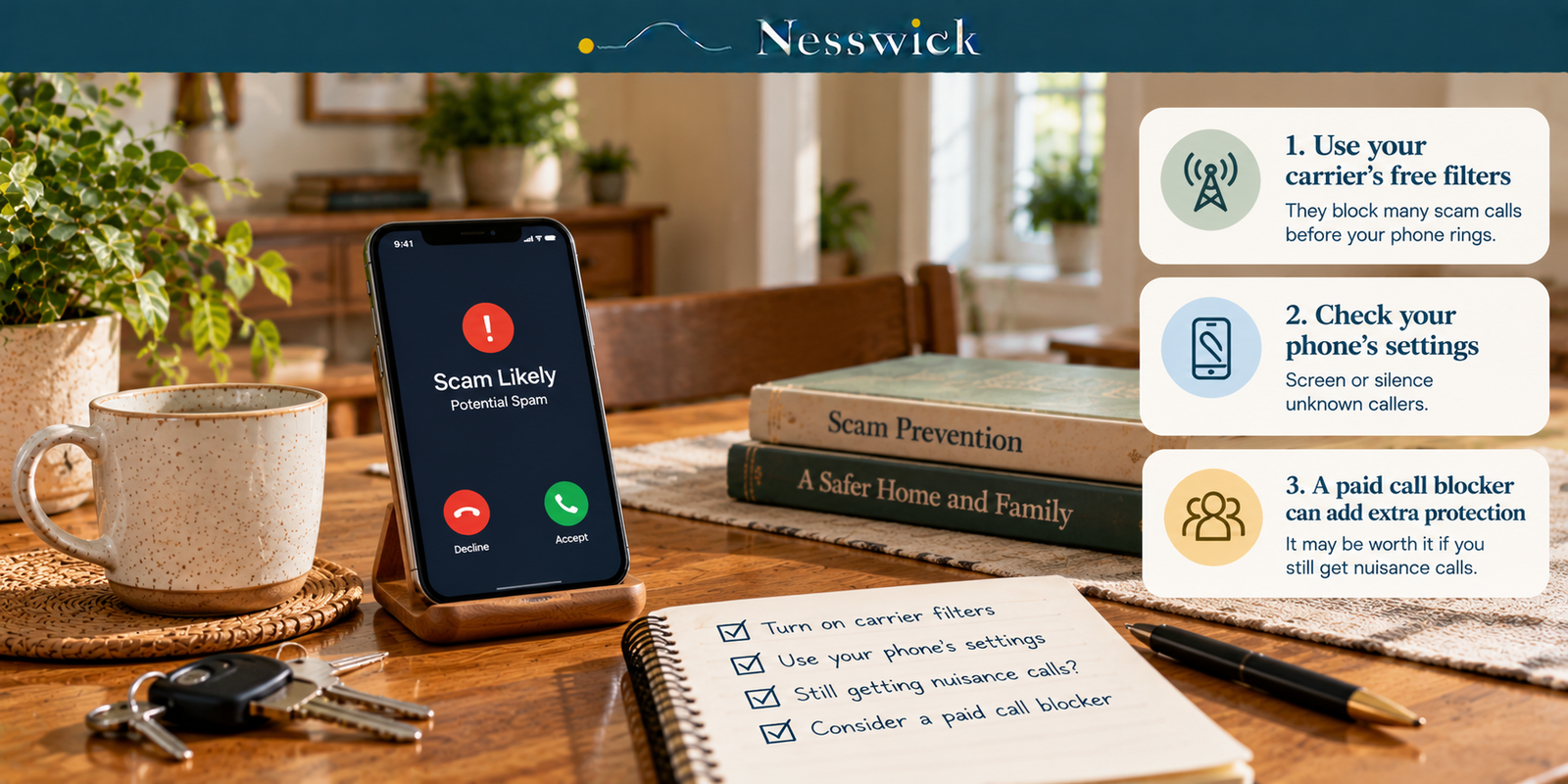
The first decision is whether you need to pay at all. Free carrier filters and built-in phone settings can already reduce unwanted calls. A paid blocker is most useful when those tools are enabled and unwanted calls or texts remain a persistent problem.
An important Nomorobo change: landline protection is back, but no longer free
Nomorobo ended its former free landline protection on 1 January 2026. Its current official pages say that landline protection has since returned as a direct subscription at $39.99 per year per line. That is different from both the old free arrangement and the company’s mobile plans. Nomorobo says many previous users may be able to reactivate their existing simultaneous-ring setup; eligibility and setup depend on their phone service.
If you see a comparison that says Nomorobo landline protection is still free, or that the service is no longer available at all, it is outdated. Check the current official landline page before deciding.
What the free layers already do
Start with your mobile carrier and phone settings. T-Mobile publishes free Scam ID and Scam Block features, though some advanced options require a paid tier. Verizon offers a free Call Filter tier for eligible plans and compatible devices, with spam detection and filtering; advanced controls are in Call Filter Plus. Other carriers may offer their own free filtering, but features, eligibility, and device support vary.
Your phone can add another layer, such as silencing unknown callers, sending suspicious calls to voicemail, or blocking specific numbers. These settings can also silence wanted calls from a doctor, school, delivery driver, or new contact. Review missed calls and voicemail regularly.
The FTC says some blocking apps are free and others charge. It also warns that blocking may stop wanted calls and that no tool will catch every unwanted caller. Try the free tools first and note what still gets through before paying for another service.
What a paid subscription may add
More call-handling controls. Depending on the product and plan, you may get more detailed screening, custom block and allow lists, caller categories, or voicemail transcription. These are not universal features: check the exact plan and your phone platform.
Text-message filtering. Some products offer filtering for spam and phishing texts in addition to calls. Check platform permissions, supported messaging apps, and the plan’s published features.
Special features. RoboKiller advertises Answer Bots that play recorded responses to suspected spammers. This is an optional nuisance-handling feature, not proof that fewer calls will reach you.
A call blocker can reduce interruptions and opportunities for phone scams, but it cannot verify that every caller is honest or prevent fraud. A familiar-looking or authenticated number is not a guarantee of trustworthiness.
Nomorobo and RoboKiller: what their published materials show
Nomorobo mobile plans. Its current homepage lists Basic at $2.99/month or $19.99/year, Max at $59.99/year, and Family at $79.99/year for up to four devices. The site labels annual offers with savings percentages; do not assume these prices or renewal terms will remain unchanged. Nomorobo also offers the separate $39.99/year-per-line landline service.
RoboKiller. Its US App Store listing advertises blocking up to 99% of spam calls and describes audio fingerprinting and Answer Bots. The App Store shows several different in-app purchase entries, including inactive options, and those entries are not a reliable single subscription quote. Check the exact offer, trial, renewal amount, platform, and cancellation terms shown at checkout before subscribing.
Do not treat the marketing percentages as measured head-to-head performance. Nomorobo advertises 100% protection from robocalls while also saying that legitimate automated calls may pass. RoboKiller advertises up to 99%. Neither figure establishes an independently verified real-world comparison for your number, carrier, or device. Nesswick has not tested either product and does not name a performance winner.
Three situations where paying may be reasonable
Your number receives persistent unwanted calls despite free filtering. A paid service may be worth a trial if you can identify a clear improvement without missing important legitimate calls.
Spam texts remain a major nuisance. Compare text-filtering features and permissions carefully; some free phone and carrier tools may already help.
You are helping an older relative manage repeated calls. Call screening can reduce interruptions, but pair it with a simple household rule: independently verify unexpected requests for money or personal information. Do not assume the app makes a caller safe.
Who should skip paying
Skip a paid app for now if you have not enabled the free carrier and phone settings, if unwanted calls are already manageable, or if missing legitimate unknown callers would be worse than the spam. For a traditional non-internet landline, the FTC recommends considering a dedicated call-blocking device; for VoIP or supported home-phone lines, ask the provider about service options, including Nomorobo’s current paid landline offering.
Three common questions
Do these apps see information about my calls? Filtering services process some call-related data, but access and data practices vary by app, platform, and plan. Read the product’s privacy policy and app-store disclosures before granting permissions.
Is a verified caller safe? No. Caller-number authentication helps assess whether the displayed number is spoofed; it does not establish the caller’s intent. If a caller requests sensitive information, hang up and contact the organization using a number you found independently.
Which product blocks more? The reviewed official marketing pages do not provide a comparable, independently validated head-to-head test. There is no evidence here to rank their real-world accuracy.



Affiliate Disclosure
Current relationship: Nesswick does not currently use affiliate links in this article. Product and service references are included for editorial purposes.
Sources and Methodology
This is a research-based assessment based on publicly available documentation. Nesswick did not install, purchase, subscribe to, or test the named apps. Provider claims about blocking percentages are identified as marketing claims, not measured results. Prices are US-dollar amounts displayed on official pages checked 12 October 2026 and may change. The article distinguishes the restored paid Nomorobo landline service from Nomorobo mobile plans and does not infer a current RoboKiller checkout price from ambiguous app-store purchase entries. No claims are made about real-world detection accuracy, false positives, battery life, ease of setup, or support quality.
Last reviewed and verified: October 12, 2026.
Sources Referenced
- Nomorobo – Landline Protection Is Back
- Nomorobo – Landline Protection, $39.99/year per line
- Nomorobo – Official mobile plan prices and feature descriptions
- Nomorobo – Family plan up to four devices
- RoboKiller – US Apple App Store listing, marketing claims, features and in-app purchases
- T-Mobile – Free Scam ID and Scam Block
- Verizon – Call Filter FAQs and free-tier eligibility
- FTC – How To Block Unwanted Calls
- FTC – Five ways to cut down on unwanted calls
Official pages checked: 12 October 2026.