
Credit Monitoring vs Identity Theft Protection Explained
After a data breach, the company involved usually offers something reassuring: free credit monitoring, usually for at least a year. Around the same time, a friend or an ad might mention that they pay for identity theft protection. Most people assume these are two names for the same thing.
They are not. The difference matters. Knowing it stops you paying for cover you already have. It also stops you trusting a narrow tool to do a broad job.
This guide is written for readers in the United States. It ends with the free step that sits underneath both.
The Short Answer
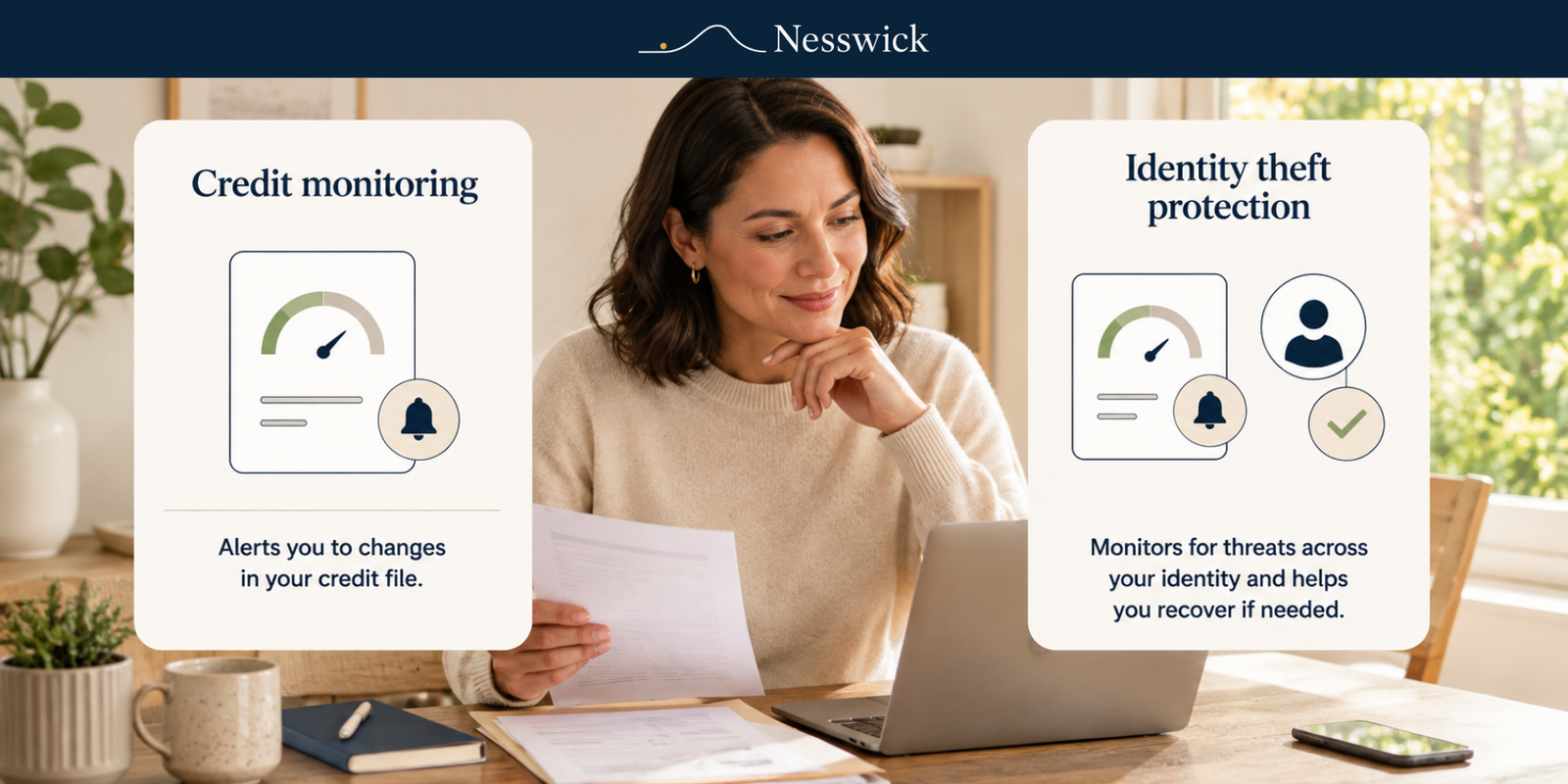
Credit monitoring watches your credit files at the credit bureaus. It alerts you when something changes. Identity theft protection is a broader paid bundle. It usually includes credit monitoring, adds identity monitoring of your personal data outside the credit file, and adds help recovering if you become a victim of identity theft.
In one line: monitoring watches. Protection watches more widely, then helps you clean up. Neither one prevents identity theft.
What Credit Monitoring Does
Credit monitoring does one focused job. It watches your credit file and alerts you when something new appears: a new account, a credit application, or a change to your records.
Coverage varies by product. The United States has three major credit reporting agencies, Equifax, Experian and TransUnion. A credit monitoring service may watch one, two or all three, so check which bureaus a product actually covers.
That early warning matters. New-account fraud is the risk most people picture when they worry about identity theft. If someone opens a card in your name, monitoring should help you notice sooner than you otherwise would.
You may already have free credit monitoring. Many banks and card issuers provide free credit scores, and some include monitoring alerts, often for a single bureau only. Some free credit apps offer it too. Companies often provide it after a breach. Check what you have before you pay for anything.
What Credit Monitoring Does Not See
Credit monitoring covers credit activity that appears on your credit report. Plenty happens outside that lane. Monitoring will not necessarily tell you if someone:
- drains or misuses an existing bank or card account
- files a tax return in your name
- uses your details to get medical care
- uses your Social Security number for employment
- posts or trades your sensitive information online
Alerts also depend on when information reaches the systems being watched, so they can lag. And watching one bureau is not the same as watching all three. Not every lender reports to every agency.
What Identity Theft Protection Does
Identity theft protection services are a package, not a single feature. Plans differ. Most combine three things on top of credit monitoring.
Identity monitoring. This looks beyond your credit file. The Consumer Financial Protection Bureau describes identity theft services as monitoring personally identifiable information in credit applications, public records, websites and other places for unusual activity. In practice, that means watching for your Social Security number, email addresses, phone number or bank details turning up where they should not.
Restoration support. Restoration is specialist help with the calls, letters, disputes and paperwork involved in putting things right. Many people find this the most valuable part. Recovery is mostly admin, and admin under stress is hard.
Identity theft insurance. This reimburses certain documented, eligible expenses up to a stated limit. Terms and exclusions vary by plan. The CFPB notes that prices and features vary widely between providers, so what one plan covers another may not.
Credit Monitoring vs Identity Theft Protection: Side by Side
- What it watches. Credit monitoring: your credit file, at one or more bureaus. Identity theft protection: your credit file plus wider personal data.
- Main job. Credit monitoring: detection. Identity theft protection: detection plus recovery support.
- Typical cost. Credit monitoring: often free. Identity theft protection: usually a subscription, sometimes as a family plan.
- Sees misuse outside your credit report. Credit monitoring: no. Identity theft protection: sometimes, depending on the plan.
- Helps you recover afterwards. Credit monitoring: no. Identity theft protection: usually, through restoration support.
- Reimburses eligible costs. Credit monitoring: no. Identity theft protection: usually, up to a stated limit.
- Prevents identity theft. Neither one does.
The Free Step Under Both: A Credit Freeze
Neither product replaces the strongest free tool you have. A credit freeze, also called a security freeze, restricts access to your credit file. Identity thieves then generally cannot open new accounts in your name.
According to the Federal Trade Commission, a credit freeze is free and does not impact your credit score. A freeze at one bureau does not cover the others, so place it at all three. You can lift it temporarily when you are applying for credit, then put it back.
That gives you a clean way to hold the whole picture together:
- A freeze is prevention. It makes new-account fraud much harder.
- Monitoring is detection. It tells you something has already happened.
- Protection adds response. It helps you deal with the aftermath.
Three different jobs. They work best together. If you only ever do one thing to protect your credit, freeze it. That costs nothing.
Our guide to whether identity theft protection is worth it covers the free steps in more depth, including fraud alerts and the FTC free recovery plan at IdentityTheft.gov.
Neither One Prevents Identity Theft
This is the most important thing to understand. It is also the point marketing most often blurs. Monitoring and protection can help you spot suspicious activity earlier and reduce the damage. No service can promise your information will never be misused.
Think of credit monitoring as a smoke alarm. The alarm tells you something is wrong so you can respond quickly. It does not put anything out. Identity theft protection adds someone to help you clear up the mess. Neither is a sprinkler system.
Two limits are worth naming plainly:
- An alert usually means something has already happened. The alert tells you to react quickly. It does not stop the event.
- Insurance is not a guarantee. Identity theft insurance reimburses specific, documented losses within set limits and conditions. It helps with the financial clean-up. It does not undo the theft.
Which One Do You Need?
Start with what is free. Place a security freeze at each bureau. Add any free credit monitoring you already have through a bank, card issuer or breach settlement. For many households, that is a strong baseline at no cost.
Credit monitoring on its own tends to be enough in ordinary circumstances. That means your exposure is normal, you are comfortable checking your credit reports and accounts yourself, and you are content to handle any clean-up alone.
A paid plan tends to earn its place when your situation is higher-risk or higher-stress. You may have already been a victim of identity theft. Your personal data may have been exposed in a serious breach. You may prefer specialists to handle a recovery. Or broader monitoring in one dashboard may buy enough peace of mind to be worth the fee.
Both are reasonable choices. Choose deliberately rather than buying the biggest plan out of worry. If you are weighing a specific paid plan, our guides to identity theft protection for families and for seniors go further into that decision.
Frequently Asked Questions
What is the difference between credit monitoring and identity theft protection?
Credit monitoring watches your credit files at the credit bureaus. It alerts you to changes such as a new account or credit application. Identity theft protection is a broader paid bundle. It usually includes credit monitoring, adds monitoring of personal data beyond your credit file, and adds restoration support plus insurance for eligible recovery costs.
Does credit monitoring cover all three credit bureaus?
Not always. Some services monitor a single bureau, some monitor two, and some monitor all three. Single-bureau monitoring is common with free offers from banks and card issuers. Check the coverage before you rely on it, because not every lender reports to every agency.
Is credit monitoring enough on its own?
For many people it is a solid part of the picture, especially paired with a free credit freeze. Monitoring watches your credit file. It does not see every kind of identity misuse, so treat it as one layer rather than complete cover.
Do I need to pay for identity theft protection if I already froze my credit?
Not necessarily. A freeze is a strong, free prevention step that addresses the risk most people worry about. A paid plan adds broader monitoring and hands-on recovery help. Some people value that, but it sits on top of a freeze rather than replacing it.
Will either of these stop my identity from being stolen?
No. They can help you notice problems sooner and recover more easily. Neither credit monitoring nor identity theft protection prevents identity theft or guarantees your information stays private.
Is identity monitoring the same as credit monitoring?
No. Credit monitoring is limited to your credit file at the credit reporting agencies. Identity monitoring looks more widely, at public records, credit applications and websites, for signs of identity theft involving your personal information.
Does free credit monitoring after a data breach cover me?
It covers the credit-file part, for as long as the offer lasts. It does not cover misuse that never reaches your credit report. It also does not include restoration help or reimbursement. Worth accepting, and worth understanding the edges of.



Related Resources

Affiliate Disclosure
Some of the identity protection services we discuss elsewhere on Nesswick may be ones we could earn a commission from if you sign up through our links, at no extra cost to you. That never changes what we recommend or how we describe these products. This article exists to explain the difference between two approaches, not to push you toward a purchase. It stays useful even if you never click a link.
Sources and Methodology
This explainer was prepared without hands-on testing. It draws on guidance from the U.S. Federal Trade Commission and IdentityTheft.gov, consumer guidance from the Consumer Financial Protection Bureau, and official credit-freeze information from the major credit bureaus. Product categories are described in general terms. Specific service features are based on current official documentation rather than testing, and are distinguished from our editorial judgment. Plans and coverage change over time, so confirm details on a provider’s official page before you decide.
Sources referenced
- Federal Trade Commission — What To Know About Credit Freezes and Fraud Alerts
- Consumer Financial Protection Bureau — What is identity monitoring or “identity theft” service?
- Consumer Financial Protection Bureau — What is a credit monitoring service?
- IdentityTheft.gov — Report identity theft and get a recovery plan