
1Password vs Dashlane: One Covers Twice as Many People
Most comparisons of these two work through feature lists. For a household the decision usually turns on something simpler and easier to check: how many people the plan covers, and what each of them actually gets.
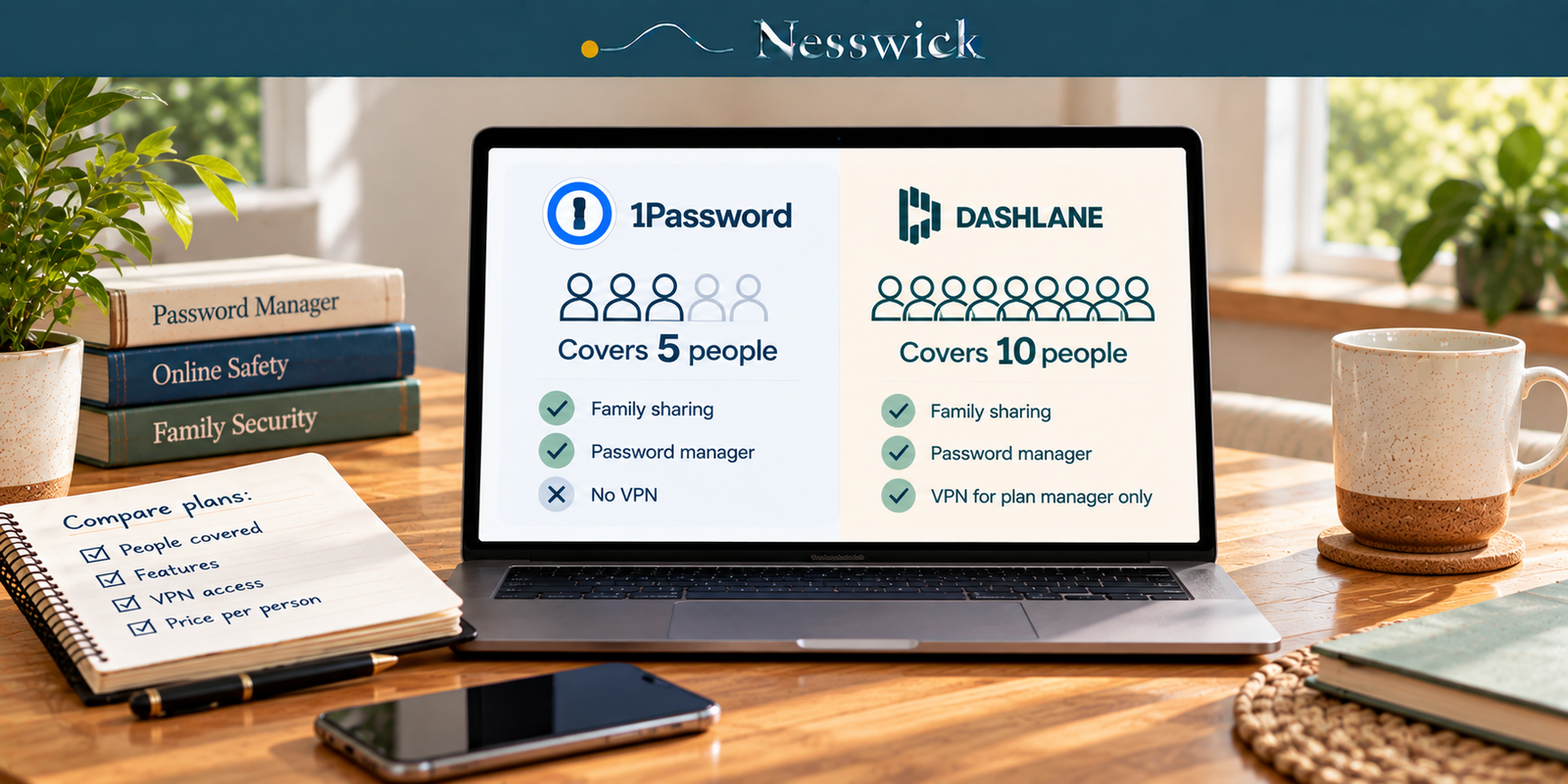
On that question the two products are not close. Dashlane’s Friends & Family plan covers 10 accounts. 1Password Families covers 5. That is a twofold difference, and it changes the per-person arithmetic more than any feature does.
Nesswick holds no account with either company. The numbers here were taken off 1Password’s and Dashlane’s published plan pages on the review date given further down.
The headcounts, and where they come from
Dashlane is unambiguous. The Friends & Family card reads “10 accounts, one subscription”, and the comparison table lists the number of members as 10.
1Password needs a note, because its own two pages word the limit differently:
- Its pricing page says “Invite up to 5 family members”
- Its support documentation says “Includes up to 5 people (with room to grow), all paid with a single subscription.”
One of those describes an action, the other a headcount, and they can be read as different numbers. We use the support page’s figure, five people in total, because it states a headcount rather than an invitation, and because it is the more precise of the two.
The phrase “with room to grow” means more members can be added. 1Password now says the base subscription includes 5 family members and that each additional family member who accepts an invitation is charged a prorated amount. It still does not publish the numeric price of that extra member, so we do not put a number on it. If your household is six or seven people, confirm that amount with 1Password before you subscribe.
What each household actually pays
Both companies show discounted rates. 1Password’s current footnote says promotional pricing is for new customers who subscribe directly through 1Password.com, for the first year with annual billing; it is not available through Google Play, the Apple App Store, or other third-party app stores. Dashlane presents one annual-billing figure without a stated first-year discount.
| 1Password Families | Dashlane Friends & Family | |
|---|---|---|
| Advertised | $4.49/month, paid annually | $8.13/month for 10 members, paid annually |
| Standing rate | $5.99/month | Same figure, no separate promotional rate stated |
| Per year, first year | $53.88 | $97.56 |
| Per year, standing | $71.88 | $97.56 |
| People covered | 5 | 10 |
| Per person per year, standing | $14.38 | $9.76 |
Dashlane costs more per household and about a third less per person. At standing rates it covers twice as many people for roughly 36% more money.
Which of those two numbers matters depends entirely on how many people you actually have. A family of four is paying 1Password for five seats and Dashlane for ten; the household figure is the one they feel in practice. A family of seven cannot use 1Password Families as sold without paying an unpublished amount for the extra members, and Dashlane covers them with three seats spare.
The VPN, and who in the household gets it
Dashlane includes a VPN, and this is where its family plan has a limitation it publishes but does not advertise.
Dashlane’s own Friends & Family card says: “Premium account for plan manager” and “Everything but VPN for plan members.” The feature comparison table confirms it, showing VPN coverage as 1 on a 10-account plan.
So on a ten-person Dashlane plan, one person gets the VPN and nine do not. If the VPN is part of why you are choosing Dashlane, it reaches the plan manager only.
1Password does not include a VPN, so there is nothing to compare on the other side. It is not a missing feature so much as a different product boundary.
Administration and getting back in
1Password spells out who is in charge. The organizer role covers the account and the vaults, and 1Password describes organizers as “responsible for managing the family and recovery”, with a pointed instruction to appoint more than one: “It’s important to have at least one other family organizer.” Two organizers means one locked-out person is not the end of the household’s access.
Dashlane’s plan manager holds the Premium account and the other nine hold accounts without VPN. Its recovery mechanics for family members are not set out on the pricing page, and we are not going to describe a process we have not seen documented.
Dashlane does state one limitation worth knowing: “Passwordless login (currently new users only)”, so an existing account may not be able to switch to it.
Both companies now document passkey support. 1Password can save passkeys and use them to sign in to compatible websites. Dashlane says users can save, use and delete passkeys on supported sites and apps.
Before either of them
A household does not need a paid family plan to stop reusing passwords.
Bitwarden Families covers six users for $47.88 a year, which is less per household than either product here and less per person than both. And Bitwarden’s free tier covers unlimited passwords on unlimited devices for one person at no cost. Our page on the best free password manager and when to upgrade works through when paying starts to make sense, and password manager benefits for families covers why a household wants one at all.
Paying is worth it when you will use what the money buys: shared vaults, an administrator who can help, breach monitoring, and in Dashlane’s case a VPN for one person. It is not worth it because a paid product is assumed to be more secure.
Sizing it to your household
Dashlane Friends & Family suits a larger household, or a household plus a few friends, the plan is named for that. Ten accounts at $97.56 is the cheapest per person of the two, and the trade is that only the plan manager gets the VPN.
1Password Families suits five people or fewer who want the organizer-and-recovery structure documented rather than assumed. At $71.88 standing it costs less per household than Dashlane.
Neither fits one or two people. Individual plans are cheaper than either family tier, and Bitwarden’s free tier may cover you entirely.
Nobody wins this one on the merits. It comes down to how many people you are covering, and whether a VPN that reaches only the plan manager counts for anything in your house.
Outside what we can check
Day-to-day quality is not assessed here at all. How each app feels, how dependably it fills a form, how fast a vault syncs, how support behaves when something breaks, none of that is knowable from a plan page, and we have not lived with either product.
Two details remain unresolved in the published material used for this comparison: the exact numeric charge for an additional 1Password family member, and Dashlane’s family-member recovery process. Passkey support is no longer unresolved: both 1Password and Dashlane currently document saving and using passkeys.

Related Resources
official pricing page
Affiliate Disclosure
Current relationship: Nesswick does not currently use affiliate links in this article. Product and service references are included for editorial purposes.
Sources and Methodology
This comparison was prepared without purchasing or running either product. Every price, member count and feature statement was read from 1Password’s and Dashlane’s own pages on the review date below. Where 1Password’s pricing page and its support documentation word the family limit differently, both wordings are quoted, the support page’s headcount is used, and the reason is given; no per-person arithmetic was performed until that wording was resolved. Per-person figures are calculated from each company’s stated plan price and member count, and the arithmetic is shown. Dashlane’s VPN limitation is quoted from its own plan card. 1Password now states that additional family members are billed at a prorated amount, but it does not publish the numeric amount used here. Dashlane’s family recovery process remains outside the pricing-page evidence used for this comparison. Passkey support was re-checked against both companies’ current support documentation.
Nesswick names no winner and makes no claim about autofill reliability, application quality, sync behaviour or support, none of which we have observed. No password manager is described here as unhackable or as the safest available, a free tier is not described as unsafe, and a paid tier is not described as automatically safer. Prices and plan structures change; confirm current figures with both companies before subscribing.
Last reviewed and verified: October 1, 2026.
Sources Referenced
- 1Password – Personal and Family Security
- 1Password – Pricing for Individuals & Families
- 1Password Support – About 1Password Families
- 1Password Support – About family organizers
- 1Password Support – Subscription billing policy
- 1Password Support – Save and sign in with passkeys
- Dashlane – Plans and Pricing, Personal
- Dashlane Support – Passkeys in Dashlane
- Bitwarden – Pricing