
Free Data-Removal Services: What the Free Tiers Actually Do
Search for a free data-removal service and you will find several, and all of them are real. The catch is not that they do not exist. It is that “free” in this market almost always means a free look at the problem, not a free fix.
That distinction is worth ten minutes of your time, because a free scan is genuinely useful and a free scan is not what most people think they are signing up for. This page sets out what each provider’s free offering actually is, where the one meaningful difference between them lies, and what free coverage does and does not reach.
What follows describes each provider’s free offering in that provider’s own terms, as their pages stood on the date recorded at the end.
The short answer
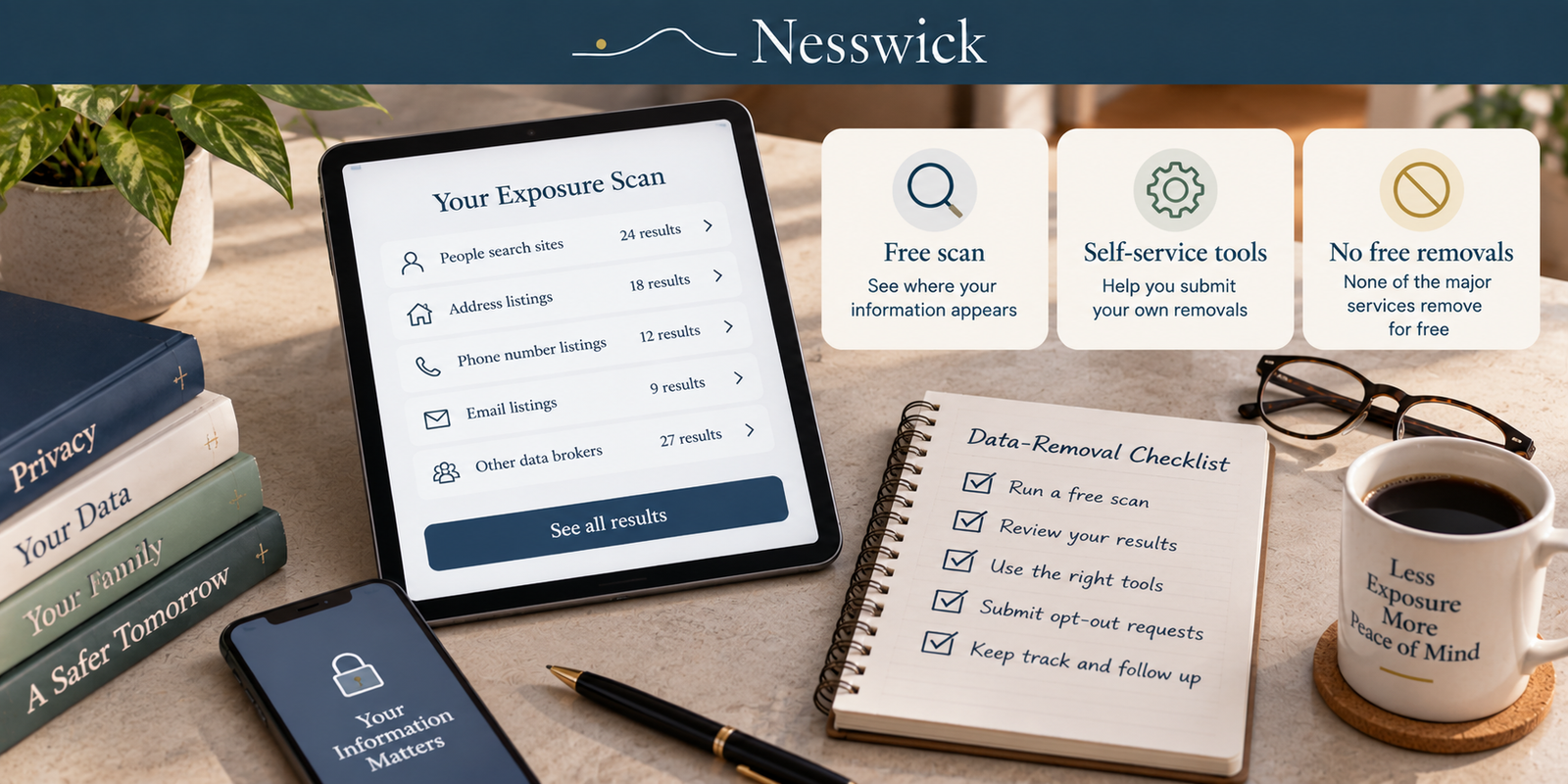
None of the major data-removal services will remove your information from data brokers for free. All of the ones covered here will show you where it appears, for nothing.
One of them, Optery, also gives you working self-service removal tools on its free tier, which makes it materially different from a scan. That is the single most useful thing on this page.
What a free tier can actually be
There are three different things a company can mean by a free offering in this category, and they are not close to equivalent.
A free scan. The service looks for your information across data brokers and shows you what it found. Nothing is submitted. You end up better informed and no less exposed.
Free self-service tools. The service shows you what it found and also gives you the means to act on it: direct links to the right opt-out pages, tracking of what you have submitted, handling of name variants and old addresses. You still do the work, but the tedious part of the work, which is finding where to go, is done for you.
Free removal. The service submits opt-out requests on your behalf at no cost. No provider covered here does this.
What each service’s free offering actually is
| Service | What the free tier gives you | Does it remove anything? | Account needed |
|---|---|---|---|
| Optery Free Basic | Personalised exposure report with screenshots, a scan of Google and Bing results, self-service removal tools, unlimited name variations and past cities for those tools | No automated removals. The tools help you submit your own | Yes, no card required |
| DeleteMe Free Scan | A scan showing what information each data broker holds on you | No. DeleteMe’s own wording is “Join DeleteMe to get this removed” | Prompts sign-up |
| Incogni Free Exposure Scanner | A scan of your exposure across sites, described as taking under a minute | No. Removal is the paid product | “Free scan, no account needed” |
| EasyOptOuts | No free tier or free scan is offered | Not applicable | Paid only, $19.99 a year |
The one difference that matters
Two of these are reports. One is a report plus a toolkit.
Optery’s Free Basic tier includes self-service removal tools, unlimited name variations for those tools, and unlimited past cities and states. Incogni’s and DeleteMe’s free offerings show you the problem and then hand you a subscription page.
If your intention is to do the opt-outs yourself, that difference decides which free tier is worth creating an account for. The report tells you where to go; the tools shorten the journey. Neither submits anything on your behalf, and Optery is explicit that automated removals begin at its paid Core tier.
Our Optery review covers what the paid tiers add, and where the free tier’s limits are.
Why nothing here removes for free
This is not a conspiracy, and it is worth understanding because it tells you what you are actually buying if you eventually pay.
Removal is not a single action. Each broker has its own opt-out route, its own verification step and its own timescale, and a submitted request has to be followed up and checked. Brokers also rebuild profiles from sources that keep producing new records, so a listing taken down in March can be back by September. The work is therefore continuous rather than one-off.
Scanning is cheap and can be automated once. Submitting, verifying and re-submitting across hundreds of brokers, indefinitely, is labour. Every service that does that part charges for it, and the prices track roughly how much of it they take on. That is the whole economic shape of the category, and it is why free tiers stop where they do.
Our guide to how long data removal takes and why information comes back covers the repopulation cycle in detail.
What a free scan is genuinely good for
Do not skip the free scan on the grounds that it removes nothing. It answers a question you cannot answer any other way, which is how exposed you actually are.
People tend to be wrong about this in both directions. Some assume a couple of stray listings and find dozens across brokers they have never heard of, with old addresses and family members attached. Others expect the worst and find their footprint is thin and largely out of date.
Those two results lead to completely different decisions. A thin result means the free route is entirely sufficient and a subscription would be money spent on very little. A heavy result means you are choosing between a lot of evenings and a subscription. You cannot make that call sensibly without the scan, and the scan costs nothing.
The free route that does remove things
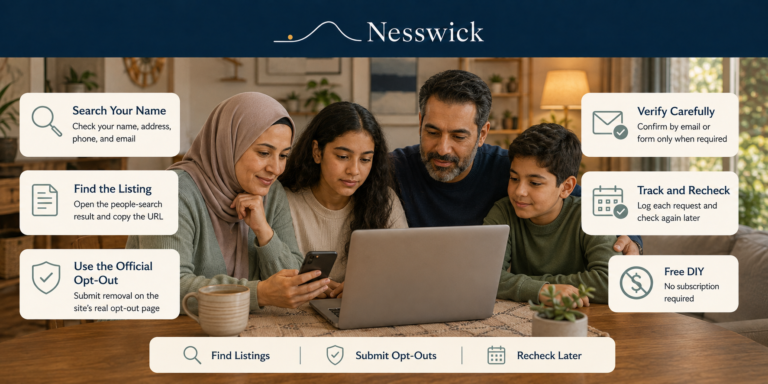
The genuinely free way to get listings taken down is to file the opt-outs yourself. Every major broker is required to offer a route, and the process is repetitive rather than difficult: find where you appear, submit the request, complete verification, record the confirmation, and check again in a month or two.
It works. It is also the reason free tiers exist in the shape they do, since the providers are effectively giving you the map and charging for the driving. Our step-by-step guide to removing yourself from people-search sites for free walks the whole process, including verification and re-checking.
If you are weighing that effort against a subscription rather than asking what free tiers contain, data removal service vs DIY is the page that answers it.
When free stops being enough
Free coverage runs out in three fairly predictable situations.
Volume. Somewhere past a few dozen listings, doing it yourself stops being an evening and becomes a project with a maintenance schedule attached. There is no fixed threshold, but the free scan will tell you which side of it you are on.
Complexity. Several past addresses, a previous surname, a commonly confused name, or a household to cover all multiply the work. Free self-service tools handle name variants; your own patience is the limiting factor.
Recurrence. The first pass is the easy part. Keeping listings down over years is the part people abandon, and it is the part a subscription is actually buying.
What free coverage does not reach at all
No free tier, and no paid data-removal subscription either, is identity-theft protection. Removing broker listings makes you harder to look up. It does not watch your credit file and it does not stop someone opening an account in your name.
There is a free answer to that problem too, and it is a different one: a freeze placed at each of the three credit bureaus, which stops new accounts being opened in your name and costs nothing. Different risk, different free tool. We cover the distinction in credit monitoring vs identity theft protection.
Run a free scan. Read what it says. Then decide whether you are buying labour or supplying it yourself, which is the only real question here.


Related Resources

FTC – Data Brokers: A Call for Transparency and Accountability
official research on the data-broker industry
Affiliate Disclosure
Current relationship: Nesswick does not currently use affiliate links in this article. Product and service references are included for editorial purposes.
Sources and Methodology
This guide was prepared without purchasing, operating or testing any of these services. What each provider’s free tier includes was read directly from that provider’s own current free-tier, scan and pricing pages on the review date below, and where a provider describes its own offering, the wording is theirs and is attributed. No claim is made about how many listings any service finds or removes, or how accurate any scan is, none of which we have measured. Free-tier contents change more often than paid pricing does, so confirm what is currently included before creating an account. Free-protection details for the credit freeze come from Federal Trade Commission consumer guidance. We name no universal winner and make no claim that data removal is complete, permanent or a form of identity-theft protection.
Last reviewed and verified: September 9, 2026.
Sources Referenced
- Optery – Official Pricing and Plans
- Incogni – Free Exposure Scanner
- Incogni – Official Pricing and Plans
- DeleteMe – Free Scan
- DeleteMe – Official Pricing and Plans
- EasyOptOuts – Official Site
- FTC – What To Know About Credit Freezes and Fraud Alerts
- FTC – Data Brokers: A Call for Transparency and Accountability