
DeleteMe Review: What It Actually Removes, What It Costs, and Who It Suits
A research-based assessment. Nesswick has not used DeleteMe as a paying customer, and nothing below is written as if we had. It comes from DeleteMe’s own documentation, from independent testing published by others, and from current government sources.
The short version
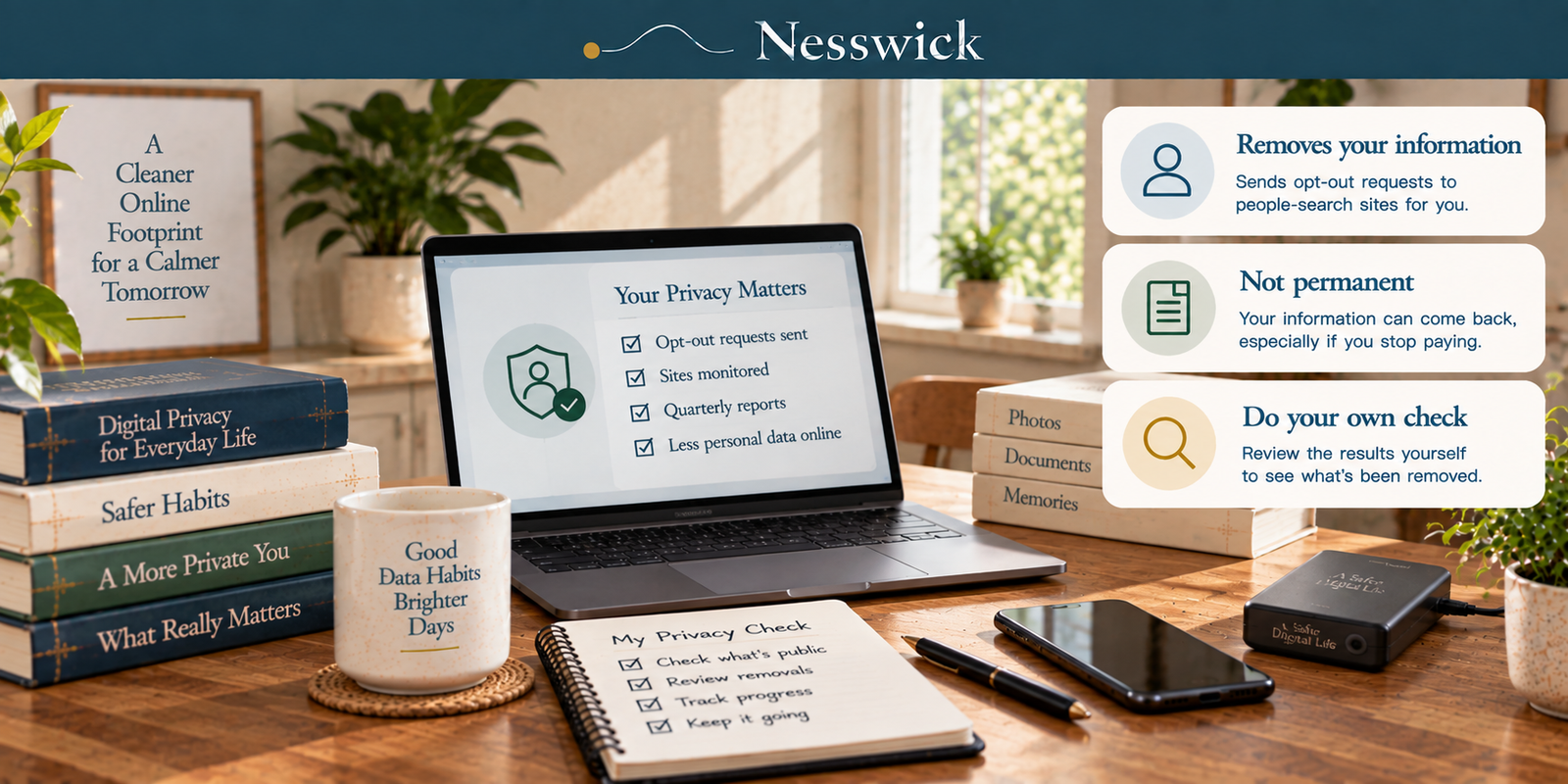
DeleteMe sends opt-out requests to people-search sites and data brokers for you, keeps re-sending them, and reports back four times a year. One person, one year: $129. It buys you out of a tedious job.
What it does not buy is permanence, and DeleteMe says so itself. Its help centre answers “will my info come back?” with “yes, your info can come back.” Stop paying and, in its words, “there’s nothing stopping the data brokers from adding your details all over again.”
So the real question is not whether DeleteMe works. It is whether $129 a year is worth not doing something you could do free. For plenty of households it is.
Before you read any review of DeleteMe, including this one
Something worth knowing about this topic. When we looked at the first page of Google results for “DeleteMe review” on 3 September 2026, three of the six editorial results were published by companies that sell a competing data-removal service. None of them said so in the review.
That does not automatically make them wrong. It does mean the pros-and-cons framing you are reading may have been written by someone with a stake in the cons. Our own position, stated plainly: Current relationship: Nesswick does not currently use affiliate links in this article. Product and service references are included for editorial purposes. We have not used the product. Everything below is sourced to DeleteMe’s own documentation or to independent research, and the last section shows you how to check the results yourself rather than take anyone’s word for it.
Start with the coverage number, because it is not what it looks like
DeleteMe’s site headlines “We Remove Private Information from 969 Data Brokers.” The same page’s own description says “over 750 data brokers.” DeleteMe’s help centre, describing what the consumer plan does, says “50+ data broker and people search sites.” And its published list of sites covered on the Standard US plan runs to roughly 90 entries.
Four numbers. All DeleteMe’s. None of them matching.
They are not describing the same thing. The largest counts across every tier, including business and enterprise plans: the page’s own asterisk notation concedes it. The $129 consumer plan is not 969 brokers.
This is not fraud; the tiering is disclosed if you read the footnotes. But if you are comparing removal services by headline coverage, you are comparing marketing to marketing. Compare the plan you would actually buy, and read the published list rather than the number above it.
There is a small irony here worth noting: DeleteMe itself links to an argument that list size is not a good measure of a removal service. It is a fair argument. It sits directly beneath a 969.
What you could do instead, for nothing
Every opt-out DeleteMe submits, you are entitled to submit yourself. Our walkthrough is How to Remove Yourself From People Search Sites for Free.
That is not a token gesture toward frugality. Consumer Reports ran a four-month study in 2024: 32 participants, seven removal services, 13 people-search sites, with a control group doing it by hand. The hand group beat every paid service tested: “Opting out manually also had quicker results, with 70% gone within a week.” DeleteMe’s four-month figure in that study was 27%.
Two caveats, both real. The study is two years old and services change. And it covered 13 sites: the grind of doing several hundred by hand is precisely what a subscription removes. But it sets the baseline honestly: you are buying time, not a better outcome than a careful person achieves.
Californians have a second free option worth using first. The state’s DROP platform has been processing deletion requests since 1 August 2026 and can send one request to registered data brokers. When a broker matches you, applicable personal information must be deleted; our family checklist explains where it fits.
What the service actually does
You hand over a datasheet. DeleteMe’s help centre lists what it needs: full name, date of birth, current address and any previous addresses, phone number, email: “the basic personal information that data brokers typically have about you.” Pause on that. It is more identifying information, assembled in one place, than most individual brokers hold about you. It is a reasonable trade for having someone search on your behalf. It is still a trade, and it is worth making deliberately.
From there DeleteMe says its staff and systems “remove it at the source, verify the takedowns, and keep monitoring.” First report in about seven days, then four privacy reports a year.
DeleteMe publishes a three-month monitoring cadence and four Privacy Reports a year. It does not clearly publish the exact interval for re-submitting every opt-out request, so neither will we.
The fine print that matters
Consumer plans are “U.S. residents only” and “Automatically renew[] unless canceled.” Separate international coverage exists for eleven countries (Australia, Belgium, Brazil, Canada, France, Germany, Republic of Ireland, Italy, the Netherlands, Singapore and the UK) sold through a different site at prices we could not verify.
On timing, DeleteMe is refreshingly plain: “Some remove your info immediately after we submit an opt-out; others take weeks.”
The refund policy is better than the industry norm and worth knowing before you commit to a year: “If you haven’t received your first Privacy Report, you can request a full refund, no questions asked,” with a pro-rated refund for unused time after that.
One contradiction to be aware of before you read the marketing. DeleteMe’s renewal page says renewing keeps your information off broker sites “for good”, and a few lines below, on the same page, “That’s why DeleteMe doesn’t work as a one-time fix.” Believe the second sentence.
Who it fits
Worth it if you are exposed across many sites and know you will not keep up; you are covering several people, or an older relative who will never do this themselves; your evenings are worth more than the fee; and you can treat it as a standing cost rather than a cure.
Skip it if you are in California and have not yet used the state’s free deletion route; you appear on a handful of sites; you would rather spend two focused evenings than an annual fee; or you are hoping to be erased, which nobody sells.
What we could not assess
We have not subscribed, so we make no judgment on the dashboard, the readability of the quarterly reports, whether “removed” in a report means removed or merely acknowledged, support responsiveness, how long the first real removals take, or whether the monitoring cadence holds in a live account.
We also will not give you a current success rate. The only measured figure we can cite is Consumer Reports’ 27% from 2024, and a two-year-old number is not today’s performance.
Any review that answers those questions should tell you how it knows.
How to check whether it’s working
This is the part no review gives you, and it is the only way to grade a removal service without taking its own scorecard on trust. It takes about twenty minutes to set up and five minutes to repeat.
Before you subscribe, take a baseline.
- Pick ten sites and write them down. A reasonable set: Whitepages, Spokeo, BeenVerified, PeopleLooker, Radaris, TruePeopleSearch, FastPeopleSearch, Intelius, MyLife and Ownerly. The specific ten matter less than using the same ten every time.
- Search your full name plus your city on each. Use a private browsing window, or your own browser will show you yesterday’s cached page and you will draw the wrong conclusion.
- For every site where you appear, save the URL and take a screenshot. Note the date.
That list is your control. It costs one evening and it is the difference between knowing and hoping.
Then re-run it at day 30 and day 90. Same ten sites, same search, private window, dated screenshots.
What the results tell you. If the service is doing its job, listings from your baseline start disappearing and the count falls between day 30 and day 90. If your ten sites look identical at day 90 to how they looked on day one, the quarterly report on your dashboard is describing work you cannot see, and DeleteMe’s refund policy gives you a pro-rated exit.
Two honest cautions. Your ten sites are a sample, not a census; a service may be clearing brokers you never checked. And a listing that reappears is not necessarily a failure, because re-collection is how this industry works, which is why the trend across three checks tells you more than any single snapshot.
Do this and you are not relying on us, or on the vendor, or on a review written by a rival. You are looking at your own name.



Affiliate Disclosure
Current relationship: Nesswick does not currently use affiliate links in this article. Product and service references are included for editorial purposes.
Sources and Methodology
This is a research-based assessment. Nesswick has not tested DeleteMe as a paying customer. No claim rests on personal experience, and several standard review questions are left unanswered rather than guessed at. We weighted sources in this order: US and California government sources; DeleteMe’s own documentation; independent published research. We did not use other review sites as sources of fact, and the reason is in the article: on the date we checked, half the page-one editorial results for this query were published by competing removal services.
Where DeleteMe’s marketing and its help centre disagree, we quote both and follow the help centre. Prices, coverage figures and country lists are dynamic and were verified on 21 September 2026; check the current price before purchasing. We do not guarantee complete or permanent removal.
Last reviewed and verified: September 21, 2026.
Sources Referenced
- DeleteMe: pricing page, “how we work”, sites-we-remove-from list, and help-centre articles on subscription cost, plan choice, how it works, monitoring cadence, removal timelines, data reappearance, renewal, refunds, signup information and international availability (joindeleteme.com, help.joindeleteme.com), verified 21 September 2026
- Consumer Reports, Data Defense: Evaluating People-Search Site Removal Services, Consumer Reports Innovation Lab with Tall Poppy, 8 August 2024
- California Privacy Protection Agency: DROP regulations §7613 (cppa.ca.gov)
- deleteme review: Direct inspection of the search results, 3 September 2026, for the composition of page one