
Talking to Kids About Online Safety, by Age
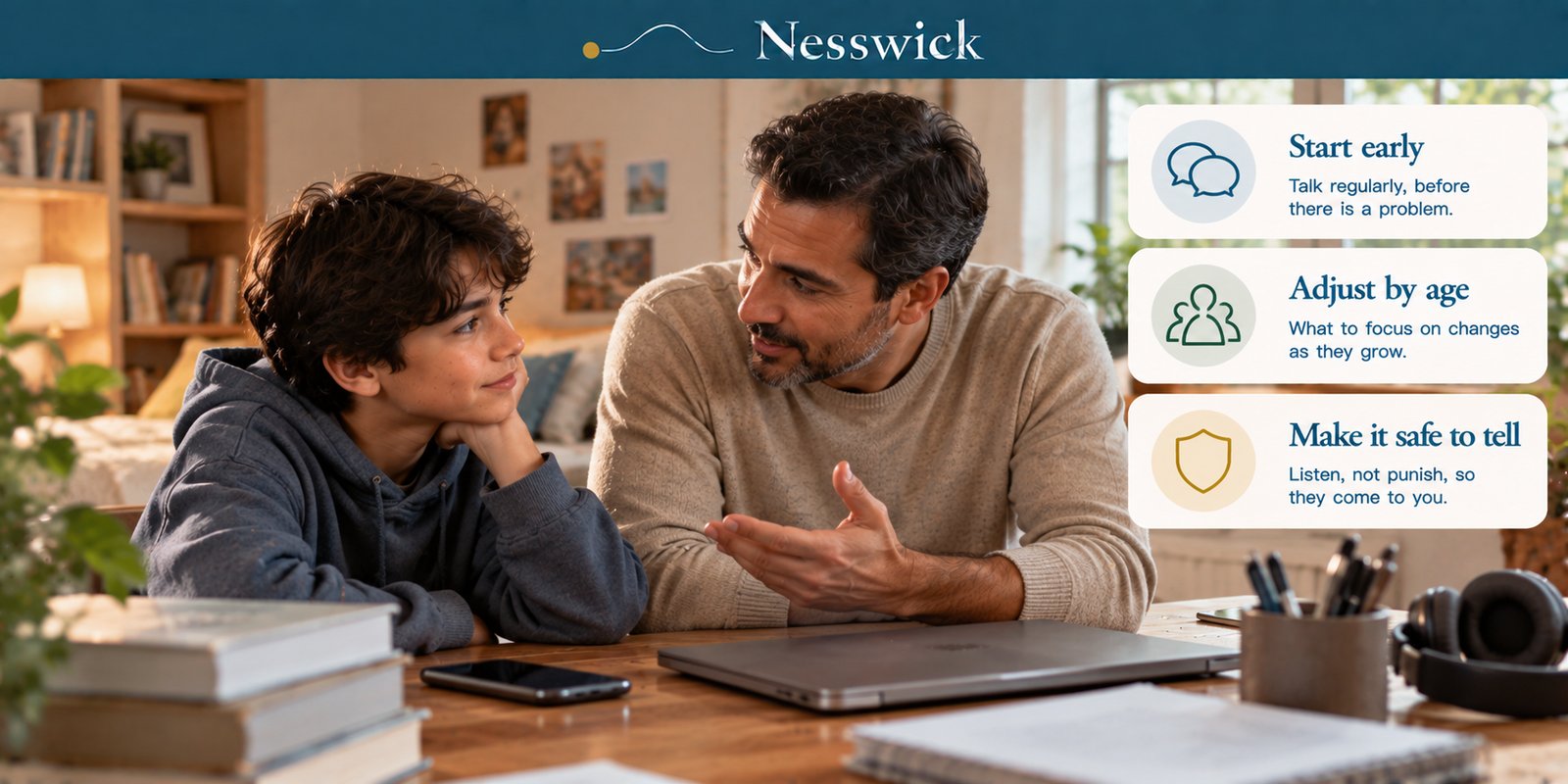
You can set every control on every device and still have the feeling that something is missing. It is not paranoia. Settings draw boundaries; they do not do any talking, and the FTC puts it bluntly: “there’s really no substitute for talking with your kid about your family’s rules and expectations.”
But “have a conversation” is not advice. What follows is built around a more specific question: when something goes wrong online, what makes a child tell an adult, and what makes them stay quiet?
The sentence that does most of the work
If you take one thing from this page, take the American Academy of Pediatrics’ version:
“Make sure your kids know they can come to you about their experiences online, even if they feel embarrassed or worried.”
Said once, that is a nice sentiment. Said before anything has happened, repeated when nothing is wrong, and then honoured on the day something is, that is a functioning safety system, and it is more use than any filter.
The three reasons children don’t tell you
The Child Mind Institute, looking at why young people fail to report harmful things online, names three barriers. They are worth knowing because each one is fixable, and because they explain why a child who seems open in general goes quiet in particular.
They don’t know how. Many “find the reporting process confusing and don’t understand how to use the tools on the platforms they frequent.”
They’re not sure it counts. They are “unsure if their experience qualifies”, that grey area where something felt wrong but might just be how people talk.
They’re worried about what happens next. “Embarrassment, fear of retaliation or escalation, and worries about anonymity are commonly reported.”
That third one has a version specific to home, and the Child Mind Institute states it plainly:
“To be able to talk openly about their issues with you, youth need to believe that it won’t result in punishment, judgment, or loss of their devices.”
This is the hard part, and it is worth sitting with. If the predictable consequence of telling you is that the phone is confiscated, then a child weighing up whether to tell you is weighing losing the phone against handling it alone. Plenty of them will choose alone. That is not defiance; it is arithmetic, and we set the terms.
None of which means no consequences ever. It means the response to someone sent me something horrible cannot be the same as the response to you were on it past midnight again. If those two produce the same outcome, you have taught them not to bring you the first one.
What that looks like at different ages
A note on the bands first, because this is where these articles usually oversell.
The authorities do not agree on where the lines fall. The AAP’s media guidance uses early childhood 0–5, school-age 6–12, teenager 13–18. The Child Mind Institute uses 0–4, 5–11, and 12 and up. The AAP itself uses a different scheme again for adolescence: early 10–13, middle 14–17, late 18–21.
None of them publishes a statement that the bands are approximate, so we are not going to attribute that reassurance to anyone. What we can say, as our own view: three respected bodies drawing the lines in three different places is a reasonable sign that they are organising conventions rather than thresholds. Use your own child’s age as a hint about which section to read first, not as an instruction.
Youngest children
The job here is small and specific: that they tell you when something feels wrong. Not that they understand privacy, or advertising, or strangers. Just the reflex.
The AAP recommends starting “regular, open-minded conversations with your children (even the youngest ones!) about their media use, and yours”, and the and yours is doing work. A parent who narrates their own screen use out loud has made the whole subject discussable.
At this age the barrier you are dismantling is the first one, they don’t know how. The answer is that the reporting tool is you. Say it in those terms: if something on the screen makes you feel funny, come and get me, you will never be in trouble for that.
Middle childhood
Now the second barrier arrives: is this even a thing worth mentioning? This is the age of the group chat that turned nasty by degrees, the game where somebody said something odd, the video that was fine until it was not.
The useful move is to lower the bar for what counts, explicitly. You don’t have to be sure it’s a problem. Weird is enough. Tell me about weird.
This is also when reporting stops being only you. NCMEC’s advice is direct: “teach your child how to report someone.” Sit with them and find the report button on the thing they actually use, before there is anything to report. It takes five minutes and it removes the I didn’t know how barrier permanently.
Somewhere around here, if a phone has arrived, is also when monitoring becomes a live question. StopBullying’s framing is fair: “monitoring apps can be useful, but pairing them with open conversations is important to ensure mutual trust.” A child who knows what is monitored and why is in a different situation from one who finds out.
Teenagers
The third barrier now dominates: what will this cost me. Reputation, independence, the device, your good opinion.
Two adjustments help.
The first is separating the two conversations for good: the one about rules and the one about harm. Say it out loud, in advance, in a boring moment: if someone is doing something to you online, that is not a rules conversation. You will not lose your phone for telling me.
The second is that the topics get more adult, and the framing has to keep up. NCMEC recommends discussing “the characteristics of healthy relationships, such as having and respecting boundaries and practicing consent,” and explaining that “both pressuring someone and being pressured into uncomfortable or unsafe sexual behaviors are not okay.” That is not an online-safety talk. It is a relationships talk that happens to include a screen.
The hardest one
Sextortion (someone obtaining an intimate image and then threatening to share it) is the conversation parents most want to avoid, and the one where the script matters most, because a child in the middle of it is being told they have ruined their life and must handle it alone.
NCMEC’s guidance to parents is one sentence, and it is worth learning by heart:
“Remind them that sextortion is a crime, it is not their fault and you are here to help them.”
Three things in order: it is a crime, it is not your fault, I am helping. NCMEC also recommends providing “resources that your child can reach out to, such as TakeItDown.NCMEC.org and CyberTipline.org”, worth knowing they exist before you need them.
One prevention point that generalises: NCMEC advises helping children understand “that they should never forward sexts they may receive from others, as limiting the image’s spread reduces the risk of it falling into dangerous hands.” That is a conversation about what to do with somebody else’s image, and it usually happens earlier than parents expect. If you are looking for a moment to say the “you will never be in trouble for telling me” sentence, this is the scenario it exists for.
The conversations that are not conversations
Most of what works does not look like a talk. NCMEC’s version: “regular check-ins about online interactions should be the norm.” The Child Mind Institute’s: “create space for low-pressure conversations about both positive and negative online experiences.”
In practice that means asking what they are playing and listening to the answer. Reacting mildly the first time something small comes up, because that is the audition for the big one. Mentioning something you saw online that annoyed or fooled you. Car journeys, where nobody has to make eye contact.
A child decides whether you are safe to tell long before there is anything to tell, and they decide it from the small stuff.
What none of this guarantees
No script makes a child safe, and no amount of conversation removes the need for the boring settings work.
Children keep things from parents who have done everything right. Sometimes the person they tell is a teacher, a sibling or a friend’s mother, and that is a good outcome: the aim is that they tell someone, not that they tell you specifically.
What repeated, ordinary, low-stakes conversation buys is a better chance that when it matters, telling an adult is on the list of things they consider. That is worth a great deal, and it is not the same as a guarantee.


Affiliate Disclosure
Current relationship: Nesswick does not currently use affiliate links in this article. Product and service references are included for editorial purposes.
Sources and Methodology
This is an editorial explainer. No product testing and no research of our own. Every factual claim is attributed to a named body (the FTC, the American Academy of Pediatrics, the Child Mind Institute, NCMEC or StopBullying.gov) and quoted rather than paraphrased where the wording matters, which for this subject is nearly everywhere.
Three deliberate restraints.
We assert no developmental psychology. Nothing here claims that children of a given age can or cannot understand a given idea. The age sections are organised by which barrier to disclosure tends to dominate, which is an editorial judgment, and it is labelled as one.
We show the age bands disagreeing rather than inventing a consensus. The AAP’s media bands (0–5, 6–12, 13–18) and the Child Mind Institute’s (0–4, 5–11, 12+) do not match, and the AAP uses a third scheme for adolescence. We looked for an authoritative statement that these bands are approximate and found none, so we do not attribute that reassurance to anyone. Reading them as conventions rather than thresholds is our conclusion, stated as ours.
We do not put words in NCMEC’s mouth. Advice about preserving evidence or blocking a sender before reporting does not appear on the tip sheet we cite, so it does not appear here.
General information for US families, not clinical, legal or psychological advice. If a child is in immediate danger, contact law enforcement.
Sources Referenced
- Federal Trade Commission – How to use parental controls to keep your kid safer online (22 April 2025) and Protecting Kids Online (consumer.ftc.gov)
- American Academy of Pediatrics – HealthyChildren.org, 12 Tips for a Digital Age and media recommendations including its age bands
- Child Mind Institute – Why young people fail to report harmful online experiences, and media guidelines by age (childmind.org)
- National Center for Missing & Exploited Children – Sextortion: What Parents Should Know (missingkids.org)
- StopBullying.gov – cyberbullying guide and digital awareness for parents
All verified 23 September 2026.