
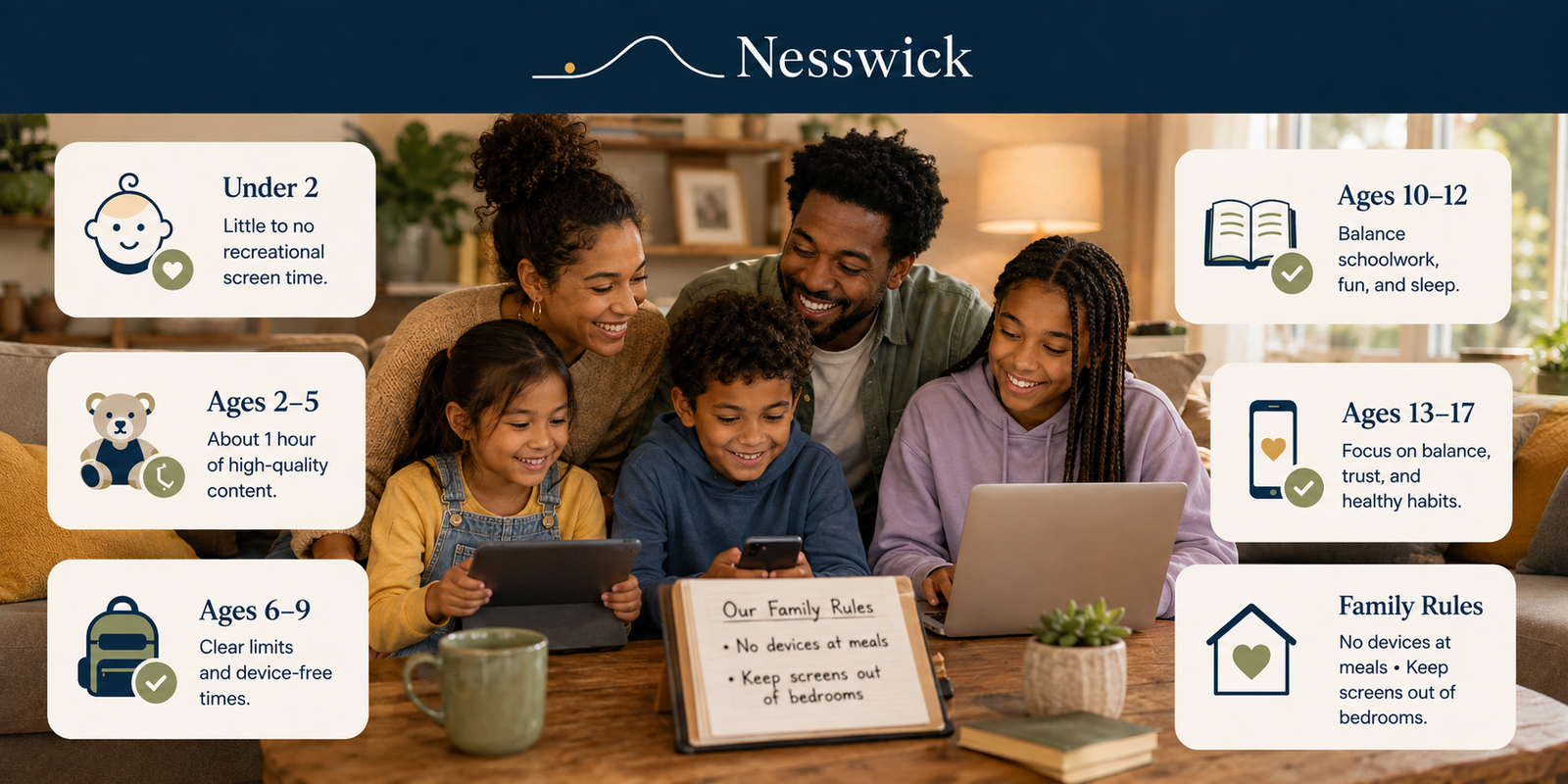
Recommended Screen Time by Age: A Practical Family Guide
Most parents searching for recommended screen time by age want one thing: a number. A clear figure per age, so the daily negotiation can finally end.
The honest answer is that the number is less settled than it looks. Official guidance still gives a useful starting point, especially for younger children, but different authorities use different frameworks, and the American Academy of Pediatrics has moved away from relying on fixed screen-time limits alone. That does not leave families with nothing. It means age is the beginning of the decision, not the end of it.
Short Answer
There is no single perfect number of screen hours for every child. Official screen time limits by age are a useful starting point, and they are clearest for the youngest children, though the frameworks differ. For under-2s, WHO advises that sedentary screen time is not recommended, while current UK guidance advises avoiding screen time other than shared activities that encourage bonding, interaction and conversation. From 2 to 5, around an hour a day of high quality content is the common figure in both WHO and UK guidance.
For school-age children and teens, the current American Academy of Pediatrics guidance does not set one universal daily hour limit. It emphasizes the child, content, context, what media crowds out, and family communication. Younger children generally need tighter limits and more co-viewing and supervision. Older children need more context, more autonomy and clear household rules rather than a stopwatch.
School and homework use should not be counted the same way as recreational scrolling. And what surrounds the screen matters alongside the minutes: sleep, physical activity, meals together and time offline. Families may need to adjust, because age is only one factor.
How Much Screen Time by Age: The Table
This is a practical starting point, not a prescription, and not a medical limit. The under-5 rows summarise official guidance and name the body it comes from, because the frameworks differ. From age 6 upward the right-hand column is Nesswick editorial judgement, offered as a household starting point rather than an official figure.
| Age | What official guidance says, and whose | Nesswick household starting point (editorial) |
|---|---|---|
| Under 1 | WHO: sedentary screen time is not recommended. UK guidance (under-2s): avoid screen time other than shared activities that encourage bonding, interaction and conversation | Video calls with family; no background TV during play |
| Age 1 | WHO: sedentary screen time is not recommended. UK guidance (under-2s): as above | Video calls with family; occasional short co-viewing with you |
| Age 2 | WHO: no more than 1 hour; less is better. UK guidance (2–5s): try to keep to no more than one hour a day | Around an hour on a normal day, watched together where possible |
| 3–5 | WHO (3–4s): no more than 1 hour; less is better. UK guidance (2–5s): no more than one hour a day; avoid at mealtimes and in the hour before bed | Around an hour on a normal day, more relaxed at weekends or at grandparents’ |
| 6–9 | AAP: no single universal daily hour limit; focus on child, content, context, crowding out and communication | A set window after homework, screens out of the bedroom, device-free meals |
| 10–12 | AAP: as above | A longer agreed window, some say over content, a firm cut-off before bed |
| 13–17 | AAP: as above | Sleep, schoolwork and offline commitments rather than a daily minute count |
Two children of the same age can reasonably land in quite different places. One who sleeps well, moves plenty and keeps up at school is in a different position from one who does not, even on identical hours.
Why the Official Numbers Have Changed
For years the quoted rules were simple: no screens before 18 months, roughly an hour a day from 2 to 5, about two hours per day for older children. Those figures came from American Academy of Pediatrics guidance issued in 2016, and are still repeated across most parenting articles.
They no longer reflect the AAP’s current position. In 2026 the AAP published new guidance, Digital Ecosystems, Children, and Adolescents. The American Academy of Pediatrics has moved away from relying on fixed screen-time limits alone, aiming instead to “move beyond simple screen-time limits and focus on quality, context and conversation.”
In place of hours, the AAP offers a framework it calls the 5 Cs, plus a free Family Media Plan:
- Child — this child’s temperament, and how digital media actually affects them
- Content — the quality of what they are watching or playing
- Calm — whether they have ways to settle and sleep that do not involve a screen
- Crowding out — what the screen displaces: sleep, play, family time, outdoors
- Communication — talking about media often enough to notice when something is wrong
The AAP is explicit that “children are all different, they don’t each have the same risks and benefits from media.”
Other authorities moved the other way. The World Health Organization’s 2019 guidelines for under-5s still give firm figures: for under-1s and 1-year-olds, “screen time is not recommended”; for ages 2 to 4, “no more than 1 hour; less is better.” And in March 2026 the UK government issued its first numeric guidance for under-5s, advising that under-2s avoid screens “other than for shared activities that encourage bonding, interaction and conversation,” and that 2 to 5-year-olds keep to “no more than one hour a day.”
These are different frameworks answering slightly different questions, not one settled rule. Where sources differ, we have said so rather than picking one and presenting it as universal.
Two figures circulate widely and are worth correcting. The CDC does not publish a household screen-time limit for parents; its child-health guidance is framed around physical activity. The NHS has no formal national screen-time guideline, though a two-hour rule of thumb appears in some of its healthy-weight advice.
Under 2
This is the age with the tightest guidance, though the authorities frame it differently rather than agreeing on one rule. WHO advises that sedentary screen time is not recommended for under-1s and 1-year-olds, and gives no shared-viewing exception. Current UK guidance for under-2s advises avoiding screen time other than shared activities that encourage bonding, interaction and conversation, which does carve out co-use. The AAP, rather than setting a fixed limit here, works from the wider quality, context and family-communication framework described above.
What they have in common is the reasoning. Young children build language and social skills from faces, voices, handling objects and back-and-forth interaction, and watching TV on its own does not supply that. Video chatting sits more comfortably than passive viewing under every framework, because a call with a grandparent is a two-way conversation.
- Video calls with family are fine and worth encouraging
- If you do watch something, watch it together and talk about it
- Turn off background television during play, which competes for attention even when nobody is watching
- Try not to make a screen the standard way to settle an upset toddler, so other ways get practised too
If this has not been your household’s pattern, that is not a failure. Change it going forward.
Ages 2 to 5
This is the band where a number genuinely exists, and the WHO and current UK guidance agree on it: around an hour a day, less if it works out that way.
Quality and context matter as much as the hour. UK guidance suggests choosing “slow-paced, age-appropriate content” and avoiding fast-paced, social-media-style video for young children. Shared viewing, where you talk and ask questions, “is better for children’s development than solo screen use.”
- Roughly an hour on a normal day, with weekends and visits to relatives allowed to differ
- No screens at mealtimes, and none in the hour before bed
- Pick the programme before you start, so the end point is already agreed
- Watch alongside them when you can and talk about what is happening
- Give a warning a few minutes before it ends, every single time
That last one does more work than any other rule here. Most arguments happen at the moment of stopping, not during the watching.
Ages 6 to 9
From here on, current AAP guidance does not set one universal daily hour limit, working instead from the child, content, context, crowding out and communication. A confident number for an 8-year-old is someone’s editorial judgement rather than an official medical limit, and worth treating as such. The suggestions below are ours, offered as a household starting point.
What replaces the number is structure. Children this age can help shape a rule, and a predictable routine is easier to keep than a daily negotiation.
- Set a window rather than a total: screens after homework, until dinner
- Keep devices out of bedrooms overnight where you reasonably can
- Keep meals device-free, adults included
- Separate schoolwork from recreation, and do not count them against the same allowance
- Let weekends differ from school days on purpose, so the difference is a rule rather than a concession
Splitting homework from leisure matters more than it sounds. A child reading on a school tablet has not used up their screen time, and treating it that way teaches them that anything on a screen is a vice.
Ages 10 to 12
Children here are old enough to want real independence and young enough to still need help stopping. Rules that worked at 7 produce arguments at 11, not because the child has changed but because the rule has not.
The move that helps most is shifting from limits you set to limits you agree. A child who helped set a rule has a stake in it, and there is far less to push against.
- Agree the limits together, and write them where everyone can see them
- Give some say over content, within boundaries you are comfortable with
- Hold the anchors firmly: sleep, meals, and a cut-off before bed
- Loosen the rest gradually rather than all at once
- Expect to renegotiate every few months
Not all screen time is equivalent. An hour spent making something, or playing with friends they know offline, is not the same hour as passive scrolling, and most children can tell the difference.
Teens, 13 to 17
Counting a teenager’s minutes rarely works, and usually costs more in trust than it returns in control. The better questions are whether they are sleeping, keeping up at school, seeing people offline and moving during the day. If those hold, the raw hour count matters much less.
What still deserves a firm line is sleep. Phones charging outside the bedroom overnight is worth defending at this age, and it is easier to hold if it applies to the adults too.
- Focus on sleep, school and offline commitments rather than a daily total
- Keep the overnight charging rule, and follow it yourself
- Talk about what they are seeing, not only how long they are on
- Give real autonomy where it has been earned, and say that you are doing so
- Stay available rather than watchful, so they tell you when something goes wrong
Heavy use is not automatically a sign of addiction. It is often boredom, a social life that lives online, or a hard week. If you are worried about a real change in mood, sleep or withdrawal, that is a conversation for your doctor rather than a matter of minutes.
Screen Time Rules for Kids That Reduce Arguments
Most of the difficulty in managing screen time is not deciding the limit. It is surviving the enforcement.
Agree the rules together where age allows. A limit a child helped set is one they have a stake in. An imposed one is something to push against.
Make routines predictable. A rule arriving at the same time daily stops being a decision and becomes just how the evening goes. Unpredictable rules get tested constantly.
Warn before transitions. The flashpoint is the moment of stopping. A five-minute warning, every time, does more than any lecture.
Model it yourself. Children notice immediately when a rule applies only to them. If meals are device-free, that includes the adults.
Protect sleep and shared time above all. If everything else has to flex in a given week, hold these two.
Let weekends differ openly. Flexibility works better as a stated rule than as one you keep failing to enforce.
Aim for consistency, not perfection. A limit you keep gently most days beats a strict one enforced only when your patience runs out. Some days go badly. That is normal.
Using Built-In Controls as a Backstop
Every major platform includes free tools that enforce a schedule so you need not be the one saying no. The order matters: agree the rule first, then set the tool to match.
Used that way, controls are a quiet backstop. The device turns off at the agreed time and nobody has to win an argument. Produced mid-argument as a punishment, they become the flashpoint.
Apple’s Screen Time is built into iPhone and iPad and includes tools such as Downtime, App Limits and Content & Privacy Restrictions. Google Family Link offers its own free screen-time controls on supported Android devices, including daily limits, app limits and schedules. The two are not identical, so it is worth reading what each actually offers on the devices your family uses. Most home routers can also pause or schedule internet access per device.
For step-by-step setup, see our guides for iPhone, Android and your home Wi-Fi router.
Two honest caveats. These tools are not tamper-proof; older children find workarounds. And no control replaces the conversation.
Reducing Screen Time Gradually
If use is well beyond where you want it, cutting sharply produces a fight and a rebound. Steps work better.
- Watch for a week without changing anything, so you know the real starting point
- Change one thing first, usually the bedtime cut-off, since it pays back in sleep quickly
- Hold it until it stops being a negotiation
- Add the next rule, such as device-free meals
- Put something in the gap, because time removed without replacement gets reclaimed
- Set the controls to match once the rule is settled, not before
Signs a Household Rule Is Not Working
- The same argument happens every day at the same moment
- You renegotiate from scratch each time, which means the rule is not predictable enough
- It is regularly broken without consequence, so it has quietly become advice
- It no longer fits the child’s age, common around 10 to 12
- You cannot keep it yourself
- Enforcing it costs more than the problem it solves
Any of these is a reason to change the rule rather than enforce it harder.
Frequently Asked Questions
How much screen time is recommended by age?
It depends whose framework you use. For under-2s, WHO advises that sedentary screen time is not recommended, while current UK guidance advises avoiding screens other than shared activities that encourage bonding and conversation. For ages 2 to 5, WHO and UK guidance both point to around an hour a day of high quality content. For school-age children and teens, current AAP guidance does not set one universal daily hour limit, so household rules and judgement take over.
Does the AAP still recommend one hour for ages 2 to 5?
Not as a standalone rule. The AAP has moved away from relying on fixed screen-time limits alone, toward quality, context and conversation, and offers a Family Media Plan. The one-hour figure still appears in WHO guidance and in current UK guidance for under-5s.
Should homework count as screen time?
It is more useful to count it separately. School use is not the same as recreational scrolling, and counting them together penalises the wrong activity.
Is two hours per day too much for a 10-year-old?
Current AAP guidance sets no universal figure to measure that against. The better test is what the time spent displaces. If sleep, school, activity and friendships are intact, two hours is a very different thing than if they are not.
Do parental control apps keep my child safe?
No tool does that on its own. Free built-in controls are good at enforcing an agreed schedule and filtering obvious content, but they can be worked around and cannot replace conversation.
The Bottom Line
Age is a sensible place to start and a poor place to stop. Official guidance is most specific for the youngest children, and for school-age children and teens the AAP works from context rather than one universal hour limit, which leaves more to household judgement.
What holds throughout is unglamorous: predictable routines, rules agreed rather than imposed, a warning before the screen goes off, adults following the same rules, and controls set quietly in the background. Fewer arguments is a reasonable goal. No arguments is not.



Affiliate Disclosure
Some links on Nesswick are affiliate links, and we may earn a small commission if you buy through them at no extra cost to you. It never affects what we recommend, and it does not apply to this article, which recommends only free built-in tools.
Sources and Methodology
This guide is research-based. We consulted current official guidance from the American Academy of Pediatrics, the World Health Organization, the UK government’s under-5s screen guidance, the CDC and the NHS, along with Apple’s and Google’s own documentation for Screen Time and Family Link. Where those sources disagree, or where a body has changed position, we have said so rather than presenting one figure as settled.
We did not carry out hands-on testing for this article, and no product was tested or ranked. Where a figure comes from an official body we have named that body, and noted where the guidance is UK rather than US. The household suggestions above age 5 are Nesswick editorial starting points, not official medical limits. None of this is medical advice, children differ, and families may need to adjust. If you have specific concerns about your child’s development, sleep or wellbeing, your doctor or health visitor is the right place to take them.
Sources Referenced
- AAP: Digital Ecosystems, Children, and Adolescents (HealthyChildren summary)
- AAP: The 5 Cs of media guidance
- WHO: physical activity, sedentary behaviour and sleep for children under 5
- UK government: screen time guidance for parents of under-5s
- NHS: healthy weight advice for parents
- Apple: use Screen Time to manage your child’s device
- Google: manage your child’s screen time with Family Link