
How to Freeze Your Child’s Credit (and What Each Bureau Asks For)
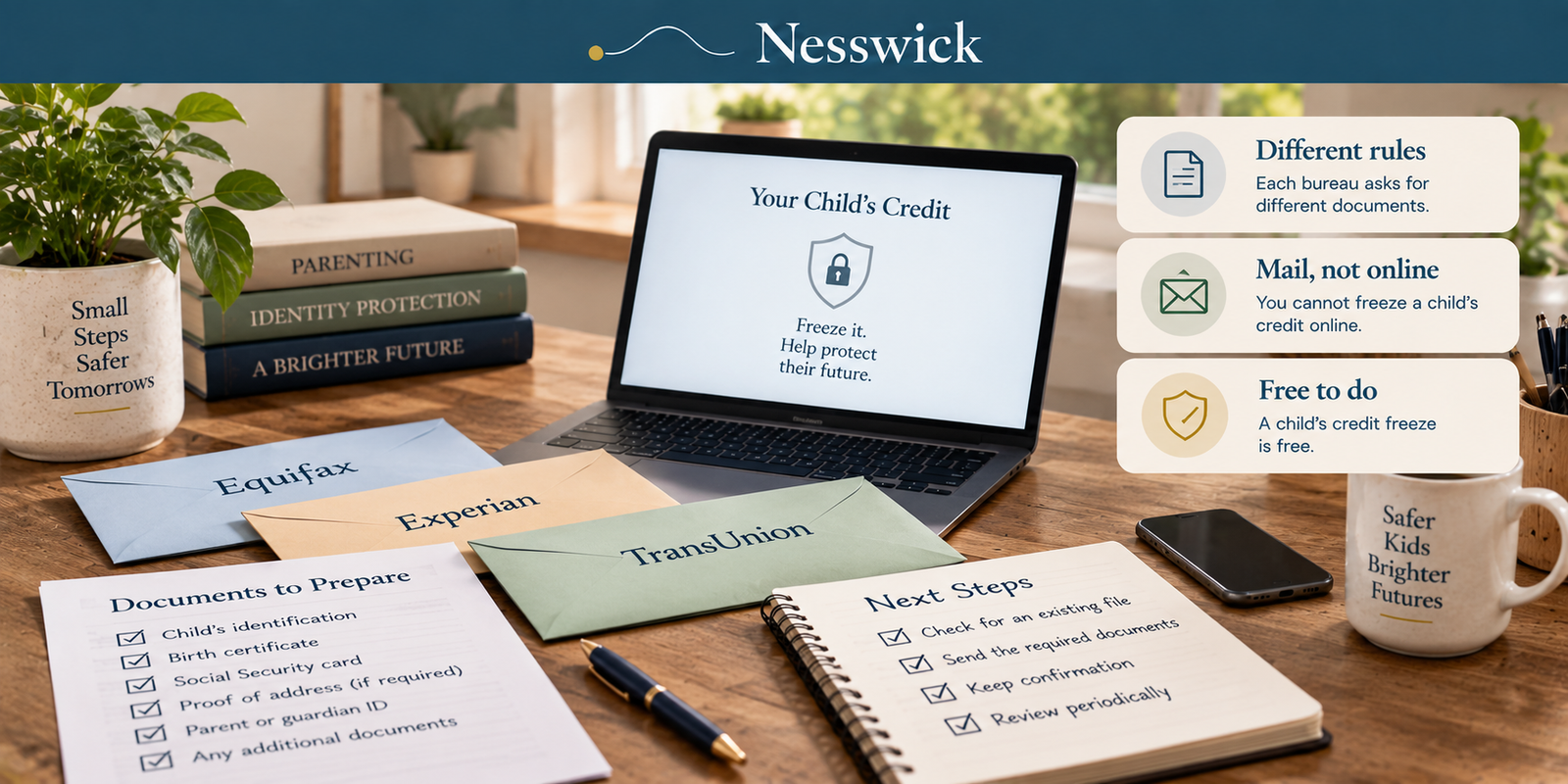
Freezing a child’s credit is free, and once it is done it mostly stays done. The awkward part is that you cannot do it online, and each of the three bureaus wants a slightly different pile of paperwork: different ages, different documents, different timelines.
So the useful thing is not another explanation of why this matters. It is knowing exactly what goes in each envelope before you start copying documents. That is the table below.
Written for readers in the United States. The reason this is worth an afternoon: a child’s credit file is not being watched by anyone, so misuse can sit undetected for years, and the FTC notes that a child under 18 generally won’t have a credit report at all.
What each bureau asks for
| Equifax | Experian | TransUnion | |
|---|---|---|---|
| Parent may request for | Child under 16 | Child under 16 | Minor aged 15 or younger |
| How to submit | Mail, with Equifax’s Minor Freeze Request Form | Mail only | |
| Child’s documents | Social Security card and birth certificate | Birth certificate and Social Security card | Certified or official birth certificate; SSN or a copy of the card |
| Your identity | Government ID, or Social Security card, or birth certificate | Driver’s licence or other government-issued ID | Driver’s licence, state ID or government-issued ID |
| Proof you may act | Birth certificate, court order, power of attorney, or foster care certification | Proof of guardianship if you are not named on the birth certificate | Court order, power of attorney, guardianship or conservator document, birth certificate, or foster care certification |
| Proof of your address | Not required | Required: bank statement, utility bill or insurance statement | Not required |
| Stated timeframe | Up to 3 business days once documents arrive | A response in most cases within 10 to 15 days | Not published |
| Creates a file for the child? | Yes: “a credit report is created for the minor and then frozen” | No: “Experian does not knowingly maintain credit information on minors in our database” | Yes: “TransUnion will create a credit file and then freeze it” |
| Says it is free | Yes | Not stated on its minor page | Yes |
| At 16 | A 16- or 17-year-old may request their own, by phone or mail | Not addressed | The minor may request removal themselves |
| At 18 | Not addressed | Not addressed | Stays in place as a protected consumer freeze if not removed |
Four notes on that table, because a few cells will raise questions.
Experian looks like the odd one out, and it is. It is the only bureau that wants proof of your address, and the only one that says it does not knowingly hold credit information on minors, which contradicts what Equifax and TransUnion say about creating a file. If you have read that all three bureaus open a file for your child and freeze it, that is not what Experian says about itself. Send to all three anyway; just expect Experian’s reply to read differently.
The age columns are not a typo. Equifax and Experian both say under 16; TransUnion says 15 and younger. In practice these overlap for almost every child, but if yours has just turned 15 or 16, check the specific bureau rather than assuming.
Experian has a separate rule that is easy to misread. It says credit reports for minors aged 13 and under “cannot be accessed online.” That governs online access, not who can have a freeze: the freeze itself covers children under 16. Either way, the parent request goes by post. On cost: the free entitlement comes from federal law and is stated by the FTC, so it holds regardless of what any one bureau’s page happens to mention.
Before you post anything: check whether there is already a file
Most parents assume there is nothing to find. Usually that is right, and this step takes ten minutes. But if something has been opened in your child’s name, you want to know before you freeze, because you will be dealing with fraud rather than prevention.
You cannot just look this up. The usual annualcreditreport.com route is built for adults with existing files. For a child, the FTC’s instruction is to “ask for a manual search for your child’s Social Security number”: you contact each bureau and request it specifically.
If the search comes back empty, carry on to the freeze. If it turns up an account, stop and read the next section first.
If fraud has already happened
Freezing is the wrong first move here. The FTC’s opening instruction is blunt: “Did someone use your child’s information to commit fraud? Call the company where the fraud occurred.”
Do that, then work through the federal recovery process at IdentityTheft.gov, which will generate a report and a plan covering the disputes you will need to raise. Come back and freeze afterwards: it stops the next account being opened, which is still worth doing, but it does nothing about one that already exists.
One document pack, three envelopes
Copy everything once. Your child’s birth certificate and Social Security card, your government ID, and (for Experian only) a recent bank statement or utility bill showing your address. Add guardianship or court paperwork if you are not named on the birth certificate. One session at the copier covers all three.
Never post an original. TransUnion asks specifically that you “only send copies of documents, not original documents.” Follow that at all three.
Get each bureau’s current form and address from the bureau. Equifax publishes a Minor Freeze Request Form to fill in and enclose; Experian and TransUnion set out what to write and where to send it. Use their pages rather than an address copied from an article, including this one. Forms and PO boxes change, and TransUnion’s protected-consumer address is not the same as its adult freeze address.
Post all three separately. A freeze at one bureau has no effect at the others.
Write down what you sent and when. If nothing comes back inside the stated window (three business days at Equifax, ten to fifteen days at Experian, unstated at TransUnion), you will want that note when you phone.
Then file the confirmations where you will find them in a decade. This is the step everyone skips, and it matters more than it sounds: you are storing paperwork your child will need as an adult, probably in a hurry, probably while applying for something. A password manager’s secure-notes area is the right home for it, and How to Set Up a Family Password Manager covers setting one up for the household.
What happens as your child gets older
The bureaus differ here, and only TransUnion addresses 18 at all.
At 16, the FTC says minors “may request and remove a security freeze themselves.” Equifax accepts a 16- or 17-year-old’s own request by phone or post; TransUnion lets a minor request removal from 16. Experian’s minor page does not address either age.
At 18, TransUnion says a freeze that has not been removed simply remains in place as a protected consumer freeze. Equifax and Experian say nothing, so ask them when the time comes.
Practically, the answer is the same everywhere: when your child is ready to apply for credit, they lift it, exactly as an adult would. Worth mentioning to them in advance: a frozen file means a declined first application, and a car dealership is a bad place to discover that.
What this does not cover
A freeze stops new credit being opened. It does not stop every misuse of a child’s Social Security number, because plenty of misuse never touches a credit file: a number can be used for employment or to file a tax return, and neither shows up in the place a freeze protects.
That is not a reason to skip it. It is the strongest free step a parent can take, and it closes the most common door. It just is not the only door.
Questions parents ask
Can I really not do this online? Not for a young child, at any of the three. The documentation requirement is why: TransUnion says so explicitly. Set aside the evening you would have spent clicking.
Why does Experian want my bank statement? It is the only bureau that asks for proof of your address. A bank statement, utility bill or insurance statement is acceptable. Leave it out and the request may come back.
Will a freeze hurt my child’s credit later? No. It creates no negative record; it blocks access until it is lifted. Your child lifts it when they need it.
My child is 16. Do I do this or do they? They can, and at Equifax and TransUnion they can also remove it. The rules are not identical across the three, so check each rather than assuming.

Affiliate Disclosure
Everything in this guide is free to do yourself. Nesswick earns nothing from the steps on this page. Current relationship: Nesswick does not currently use affiliate links in this article. Product and service references are included for editorial purposes.
Sources and Methodology
This is an official-documentation guide. No hands-on testing was performed: Nesswick did not submit freeze requests. Every procedural detail comes from the FTC’s current consumer guidance or from the bureau that imposes it, verified 14 September 2026.
Where the bureaus contradict one another we say so rather than smoothing it over, and where a bureau publishes nothing (TransUnion’s processing time, Experian’s cost statement, Experian’s position at 16 and 18), we say that too instead of supplying a figure.
One note on our own record. An earlier version of this guide removed the FTC as the source for minors aged 16 or 17 requesting their own freeze, because the relevant FTC page would not load when we checked. It loaded this time and states it plainly, so the attribution is restored.
Bureau forms, documents and PO boxes change. Verify against each bureau’s current page before you post anything. General information for US readers, not legal or financial advice; no freeze prevents every kind of identity theft.
Last reviewed and verified: September 14, 2026.
Sources Referenced
- Federal Trade Commission: “Credit Freezes and Fraud Alerts” and “How To Protect Your Child From Identity Theft” (consumer.ftc.gov), verified 14 September 2026
- Federal Trade Commission: Identity Theft: A Recovery Plan (publication 501a), for the fraud-already-happened step
- Federal Trade Commission: 2018 press release on the federal law making freezes free
- Equifax: minor credit freeze help article and Minor Freeze Request Form (PDF)
- Experian: “Child Identity Theft Services” help page and its main credit freeze page
- TransUnion: credit freeze FAQ (protected consumer freeze section)