
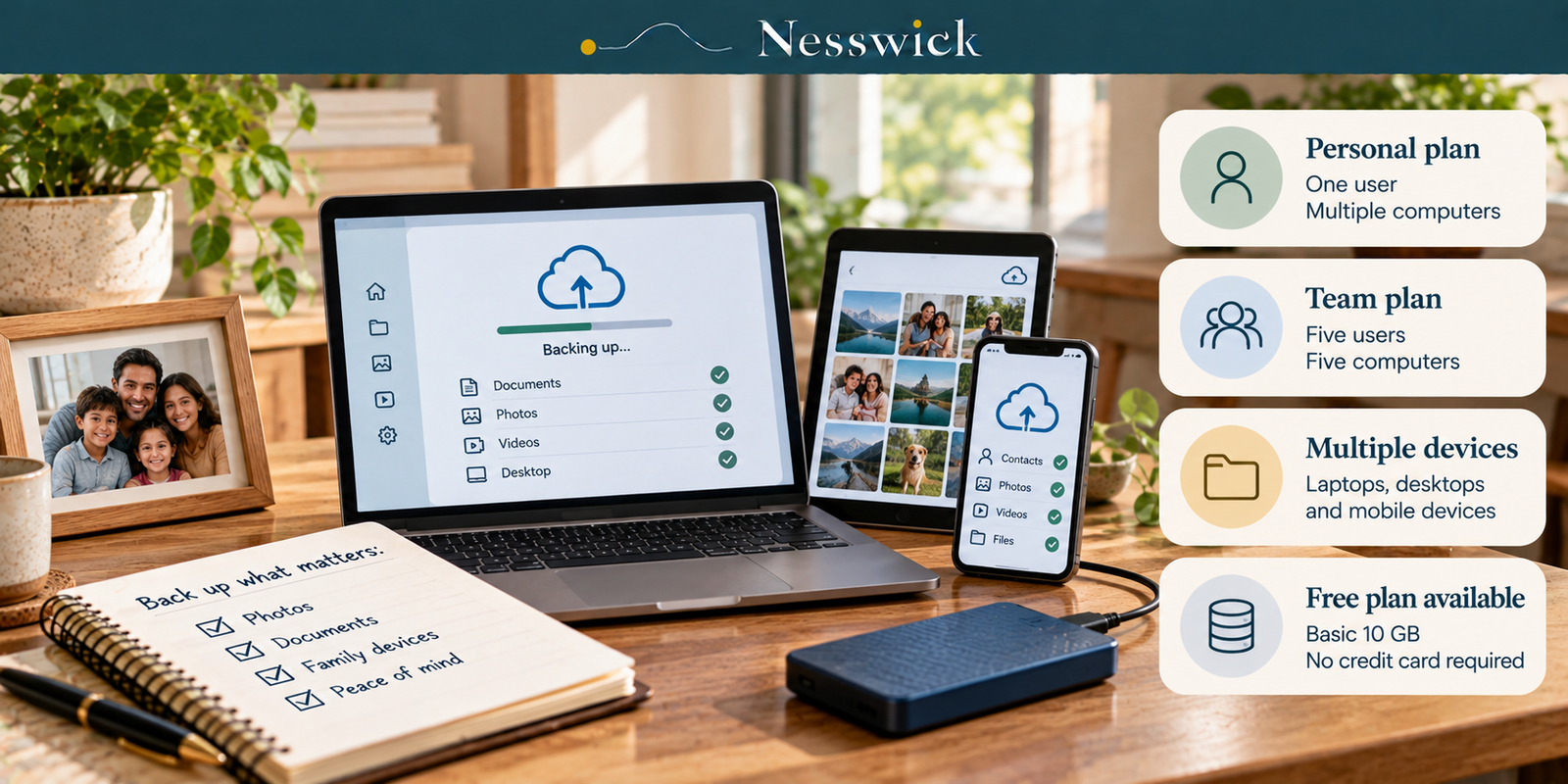
IDrive Review: Personal Is Not the Family Plan
Two things about IDrive get repeated everywhere and both are slightly wrong.
The first is that IDrive is “the multi-device one.” It is, but the word doing the work is device, not person, and for a household those are not the same thing. The second is the price. The $6.99 a month you see quoted is a first-year rate, and IDrive says so itself, in a note printed under the plan grid.
Neither of those makes IDrive a bad product. Both change the arithmetic.
Nesswick has not subscribed to or run IDrive. Everything below was read from IDrive’s own pricing and feature pages on the date given at the foot of this review.
Personal, Team, and the difference that matters
IDrive labels its plans on the pricing grid itself, and the labels are precise:
| Plan | Storage | IDrive’s own description |
|---|---|---|
| Basic | 10 GB | Free, “No credit card required” |
| IDrive Mini | 100 GB | “One user” |
| IDrive Personal | 5 TB and up | “One user, Multiple computers” |
| IDrive Team | 5 TB and up | “Five Computers, Five Users” |
| IDrive Business | 500 GB and up | “Unlimited users, Multiple computers and servers” |
Read the Personal row again. One user, multiple computers. That is a plan for one person who owns a laptop, a desktop and a phone. It is not a plan for four people who each own a laptop.
For a household where everyone has their own machine and their own account, the plan that matches is Team, described as five computers and five users. On the annual rate that is the same headline price as Personal at the same storage tier, but it is a different product, and confusing the two is the most common error in reviews of this service.
Whether Personal technically permits a family to share one login is not something IDrive states plainly on the pricing page, and it is not something we will infer. If several people in your home need their own accounts, Team is the plan that says so.
The price, and the note underneath it
IDrive shows three billing tabs. The prices differ more than the tabs suggest.
| Billing | IDrive Personal, 5 TB |
|---|---|
| Monthly | $11.99 a month, or $143.88 across a year |
| Yearly (the default tab) | $9.99 struck through, $6.99 a month, or $83.88 for the first year |
| Two years | $239.76 struck through, $179.82 for two years |
Beneath the grid, on every tab, IDrive prints this:
“Note: The discounted price applies to the first year of the selected plan. Standard pricing will apply from the second year onward.”
That sentence is the review. The $6.99 is year one. The struck-through $9.99 is what you pay from year two, and the two-year figures confirm it: $239.76 ÷ 2 is $119.88 a year, which is $9.99 a month. The standard rate is not hidden. It is the number with a line through it.
So a household committing to IDrive Personal at 5 TB should plan for:
- Year one: $83.88
- Year two and after: $119.88 a year
- Or $179.82 for two years paid up front, which is the cheapest route if you are confident
Nothing about this is unusual in the industry. It is only a problem when a comparison puts the $6.99 next to a competitor’s standing price, which is exactly what most of them do.
What you get for the storage
Version history. IDrive’s feature documentation states it “retains upto 30 previous versions of all files backed up to your account.” That is a count of versions, not a length of time, which behaves differently from a rolling window: thirty versions of a file you edit daily covers about a month, and thirty versions of a file you touch twice a year covers fifteen years.
Snapshots, in IDrive’s words, “provide historical view of data for point-in-time recovery and help protect against ransomware.” The phrase to notice is help protect. It is a recovery mechanism, not immunity.
IDrive Express is physical shipment for large backups or restores: “Quick backup and retrieval of data in less than a week via physical storage shipment, ensuring no bandwidth usage.” IDrive describes the service as free, and states that business subscribers receive it three times a year. What the allowance is on a Personal plan is not stated on the pages we read, and we are not going to guess at it.
Encryption. IDrive’s wording: “Transfer and store files with 256-bit AES encryption using a user-defined key that is not stored anywhere on the servers.” That model gives the account holder control over the key, and it comes with a trade-off worth understanding before you switch it on: if the key is lost, recovery may not be possible, because by IDrive’s own description the key is not held on its servers. It is a choice about who carries the risk, not a ranking against other designs.
What a household actually decides here
The question is not really “is IDrive good.” It is which of two shapes your home is.
One person, several machines. Personal at 5 TB, $83.88 the first year and $119.88 after. This is the case IDrive is built for and priced well for.
Several people, several machines, separate accounts. Team. Look at the five-user tier and price it against what you would pay for individual subscriptions elsewhere, because that comparison is usually where IDrive wins.
One computer holding everything, and a lot of it. A quota starts working against you. An unlimited-data service on a single machine may cost less. We put that comparison side by side in Backblaze vs IDrive.
Almost nothing to protect. The free 10 GB Basic tier exists and requires no card. Start there and find out how much you actually need before paying for 5 TB.
Backup is not sync, and IDrive is backup
IDrive backs up. It does not keep a folder matched across your devices the way a storage service does, and it should not be judged as though it did. If what you want is a shared family folder that updates everywhere, that is cloud storage, a different category with different products, which we cover in best cloud storage for family photos.
The reverse error is more dangerous. A synced folder is not a backup: delete a file in a sync service and it disappears everywhere, which is precisely what a backup is meant to prevent.
The gaps, named
No subscription was bought, so this review is silent on how fast the service is, how long a first upload runs, how the apps feel to use, and how support responds. Several page-one reviews measure those properly. This one does not pretend to.
Two gaps stay open. IDrive does not publish the Express allowance that applies to a Personal subscriber, and we have not confirmed where its data centres sit. Ask IDrive directly rather than trusting a third-party figure, ours included.
No backup service can promise a restore. A backup that reports success has not been tested until you have pulled a file back out of it.


Related Resources

Affiliate Disclosure
Current relationship: Nesswick does not currently use affiliate links in this article. Product and service references are included for editorial purposes.
Sources and Methodology
This review was prepared without subscribing to, installing or running IDrive. Every plan name, price, user and computer description, storage quota, version count and feature statement was read directly from IDrive’s own pricing and feature pages on the review date below, with each billing tab clicked and the rendered grid read rather than inferred. The renewal note is quoted verbatim because it changes the cost of the plan and appears only beneath the grid. Annual and two-year equivalents are calculated from IDrive’s stated figures and the arithmetic is shown. Where IDrive does not publish a detail (the IDrive Express allowance on a Personal subscription, and data-centre location), this review says so and directs the reader to confirm it, rather than sourcing it from a third-party review. Nesswick makes no claim about upload or restore speed, application quality, reliability or support, none of which we have observed. Snapshots are described using IDrive’s own “help protect” wording and are not presented as ransomware immunity. A completed backup is not a guaranteed restore. Pricing and plan structure change; confirm current figures with IDrive before subscribing, particularly the second-year rate.
Last reviewed and verified: October 8, 2026.