

What Age Should a Child Get a Phone? There Is No Number
You are probably here because someone told you a number. Ten. Twelve. Fourteen. Not until high school.
Whoever told you that may have a good reason for it. What they were not doing is quoting the largest paediatric body in the country, because it declines to give a number. The American Academy of Pediatrics does not set a universal age for a first phone. Its guidance for parents considering one asks readiness questions and leaves the age alone.
That is genuinely the answer, and it is more useful than a number would be. A rule that says “twelve” tells you nothing about the eleven-year-old who walks home alone and the thirteen-year-old who loses a coat a week.
So this page does two things. It sets out what to actually check, using the questions the AAP publishes. And if you decide yes, it points you at the specific things worth setting up first.
What the paediatricians actually say
The AAP’s guidance for parents considering a first phone is built around five questions. In its own words:
- “Has your child thought through how they would want to use the phone?”
- “What are your child’s unique strengths and challenges that might make having a phone more difficult?”
- “How would you know your child is being a responsible phone user?”
- “What are the other ways they can connect with friends?”
- “Do you have a regular way to check in with them about how life is going (including their digital life)?”
Its centre on social media and youth mental health puts the same point more directly: “smartphone readiness has more to do with their own levels of responsibility and whether their parents were ready to help them create rules and navigate their relationship with the phone.”
Notice how much of that is about the household rather than the child. Two of the five questions are aimed at the parent. That is not padding. It reflects that a phone in a home with no habit of talking about it is a different object from the same phone in a home that has that habit.
Working through it
Here is how those questions land in practice, without adding anything the AAP did not say.
Does the phone solve a real problem? Walking home, getting to practice, a parent working late, split households. A concrete logistical need is the strongest reason on this list, and it is also the reason that points at the simplest device rather than the most capable one. “Everyone else has one” is a real social pressure and a poor engineering brief.
Has your child thought about what they would do with it? A child who says “message my friends and look up football” has thought about it. A child who says “I don’t know, everything” has not. This is the AAP’s first question and it is a surprisingly good filter.
Do they already keep agreements you have made? Not perfectly; nobody does. But is there a track record? Bedtime, homework, coming in when called. A phone adds a large new category of agreement to a relationship, and it goes best where the smaller ones mostly hold.
Will they tell you when something goes wrong? This is the one that matters most and the hardest to assess. The question is not whether your child is honest in general. It is whether they believe that bringing you a problem will make things better rather than worse. If a child expects the phone to be confiscated the moment anything happens, they will hide the thing that happened.
Can they keep track of it? Phones get left on buses. This is not a character judgment, it is a practical one about what you are prepared to replace.
Are you ready for the ongoing part? The AAP’s fifth question. A first phone is not a purchase, it is the start of a running conversation. If there is no regular moment when you talk about how things are going, that is worth building before the phone arrives rather than after.
What supervision are you planning, and does your child know? Deciding this before the phone is handed over is much easier than retrofitting it. Whatever you choose, telling them what it is beats them finding out.
If most of these land well, you have an answer. If several do not, you also have an answer, and it comes with a list of what would have to change.
The middle options
The question is often framed as phone or no phone. There is more room than that.
A basic phone that calls and texts solves the logistics problem (the child can reach you, you can reach them) without the internet, apps or social media. For a household where the actual need is contact, this is frequently the right answer and it removes most of what the worry is about.
A smartwatch with calling does the same for younger children who would lose a phone.
A shared family phone, kept in the kitchen and taken when needed, is another shape.
A smartphone with the internet off at the start, opening capabilities over months, treats the decision as a sequence rather than a switch. The AAP’s guidance frames phone ownership as something to approach like an experiment, tied to demonstrated responsibility, and this is what that looks like in practice.
None of these is a compromise. They are different answers to different needs.
If the answer is yes
Three things worth doing in the first week, each covered properly elsewhere on this site.
Set up the built-in controls before you hand it over. Both platforms include them at no cost, and doing it first avoids a negotiation about taking capabilities away later. Our step-by-step guides cover parental controls on iPhone and parental controls on Android.
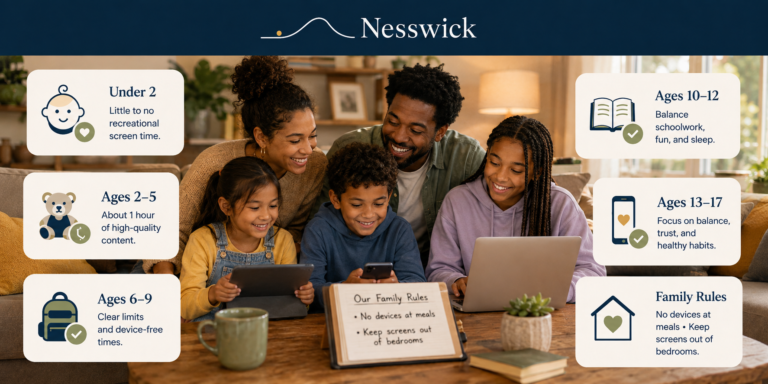
Agree what “how much” looks like rather than discovering it by argument in week three. Recommended screen time by age sets out what the current guidance actually says by age band, including for teenagers.
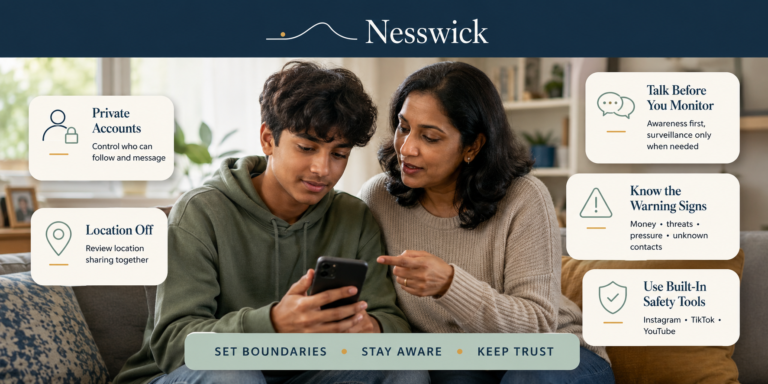
Decide about social media separately. A phone and a social media account are two decisions, and they do not have to happen on the same day. Most platforms set their own minimum ages. When you get there, social media safety for teens covers the monitoring-versus-trust question, which is a genuinely difficult one.
If your household has a router you can configure, parental controls on your home wifi router covers the devices that never leave the house.
Two things worth saying plainly
A first phone is reversible. If it is not working, whether that shows up as sleep, school, mood or arguments, it can go back to a basic phone for a while. Framing it as a step rather than a threshold makes that much easier for everyone, and it is closer to how the AAP describes the decision anyway.
No age, and no set of controls, makes a phone safe. Controls filter and limit; they do not supervise, and children who want to get around them often can. The thing that reliably helps is a child who will tell you when something happens. Every readiness question above is really circling that one.
What this page does not claim
Nesswick is not a paediatric or psychological authority and does not set an age. Where guidance is quoted above it is the American Academy of Pediatrics’, reproduced as published, and readers should check it directly. What this page establishes is that the AAP declines to name a universal age; it does not survey every organisation that might have an opinion.
We make no claim about what any particular child is capable of at any particular age. The readiness questions are the AAP’s framework and a household’s judgment; they are not a test with a score.
We are not recommending or ranking any phone, watch, carrier or app, and we make no claim about the effectiveness of any parental-control product.
Affiliate Disclosure
Current relationship: Nesswick does not currently use affiliate links in this article. Product and service references are included for editorial purposes.
Sources and Methodology
This page was written from published guidance rather than from testing or clinical expertise. The readiness questions are quoted from the American Academy of Pediatrics as they appear on HealthyChildren.org and on the AAP’s Center of Excellence on Social Media and Youth Mental Health, checked on the date below. Nesswick states that no age threshold appears in the two AAP pages reviewed, and attributes no specific age to the AAP. That finding is scoped to those pages: Nesswick did not survey every paediatric or regulatory body and makes no claim about what others may have published. The practical framing that follows the quoted questions is Nesswick’s own interpretation and is labelled as such rather than presented as clinical advice. No claim is made about any individual child’s development, capability or maturity at any age, and no developmental precision is asserted beyond what the cited guidance states. Device alternatives are described by what they do, not ranked, and no phone, watch, carrier, plan or parental-control product is recommended. Nesswick makes no claim about the effectiveness of any parental-control tool. Guidance from paediatric bodies is revised; check the linked pages directly before relying on them.
Last reviewed and verified: September 13, 2026.